“Managing priorities helps children plan their day in a smart and simple way. By choosing important tasks first, kids can finish work on time and feel relaxed. A clear plan saves energy, builds focus, and leaves space for games and family time. Good priorities make daily life smooth and happy.”
5 Pointers on “Managing Priorities”
- Managing priorities means deciding what is most important to do first.
- It helps children finish important tasks on time without stress.
- Making a simple list helps in organizing work and play.
- Good priorities teach responsibility and self-discipline.
- Managing priorities leaves time for fun, rest, and family.
‘Managing Priorities’ Paragraph Writing
Hamburger Paragraph on ‘Managing Priorities’ (Free Template)
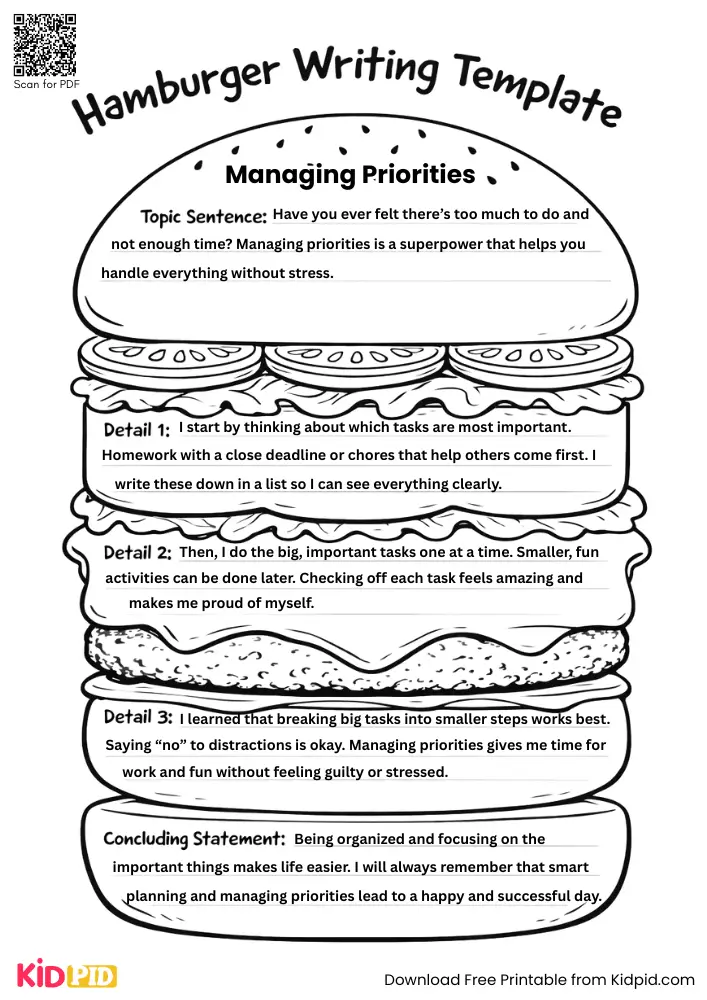
Topic Sentence : Have you ever felt there’s too much to do and not enough time? Managing priorities is a superpower that helps you handle everything without stress.
Details 1 : I start by thinking about which tasks are most important. Homework with a close deadline or chores that help others come first. I write these down in a list so I can see everything clearly.
Details 2 : Then, I do the big, important tasks one at a time. Smaller, fun activities can be done later. Checking off each task feels amazing and makes me proud of myself.
Details 3 : I learned that breaking big tasks into smaller steps works best. Saying “no” to distractions is okay. Managing priorities gives me time for work and fun without feeling guilty or stressed.
Concluding Statement : Being organized and focusing on the important things makes life easier. I will always remember that smart planning and managing priorities lead to a happy and successful day.
Short Paragraph on ‘Managing Priorities’ – 50 Words for Grade 3
Managing priorities means deciding what is most important. Write down your tasks. Do the biggest or hardest thing first. This is called “eating the frog.” Finish one job before starting another. Check things off your list. This helps you stay calm and get everything done.
Long Paragraph on ‘Managing Priorities’ – 100 Words for Grade 4
Managing priorities is about choosing what to do first. Start by making a simple list of everything you need to do. Look at your list and pick the most important task—maybe it’s homework or cleaning your room. Do that big thing first; it feels great to get it done! Work on one thing at a time until it’s finished, then check it off. This helps you not feel overwhelmed. Remember, it’s okay to ask for help if you have too much to do. By planning your time, you can finish your work and still have time for fun.
‘Managing Priorities’ Essay Writing
‘Managing Priorities’ – 150 to 200 Words for Grades 5 to 7 Students
Imagine your day is a big, empty treasure chest. Your tasks—homework, chores, playing, reading—are all different gems. Managing priorities is learning how to fill that chest wisely, so you get the most valuable treasure: a happy, successful day without stress!
It starts with knowing which gems are the rarest and most important. The big, shiny gem that’s your homework due tomorrow needs to go in first. The fun, sparkly gem of video games can fit in later. By doing the most important thing first, you make room for everything else and you don’t have to worry about it anymore! It’s like eating your vegetables before dessert—it makes the treat even sweeter.
Making a simple list can be your treasure map. When you write down “1. Math sheet, 2. Clean room, 3. Soccer practice,” you have a plan. Checking each thing off your list feels amazing! Remember, managing your priorities isn’t about working all the time; it’s about organizing your time so you have plenty of time for both work and wonderful play.
‘Managing Priorities’ – 300 Words Essay for Grades 8 to 10 Students
Have you ever felt like there’s too much to do and not enough time? Your homework is calling, your room is messy, you promised to walk the dog, and your favorite show is on! This is where learning to manage priorities becomes your superpower. It means being the captain of your own ship, steering through the sea of tasks without crashing into Stress Island!
First, think like a captain. A captain knows that fixing a leak in the boat is more urgent than polishing the deck. For you, this means asking: “What needs to be done first?” Usually, it’s the task with the closest deadline (like a quiz tomorrow) or the one that helps others (like feeding your pet). These are your “big rocks.” A famous trick is to put your big rocks in a jar first. If you fill the jar with sand (tiny, fun things) first, the big rocks won’t fit. But if you put the big rocks in first, the sand can trickle around them, and everything fits!
Next, make your navigation chart—a to-do list! Writing “Read history chapter” and “Practice piano” gets them out of your buzzing brain. Now you can see your journey clearly. Then, break down any giant, scary task (a “sea monster”) into tiny, friendly parts. “Write book report” becomes: 1) Choose a book, 2) Read the first 3 chapters, 3) Write one paragraph. Small steps lead to big finishes!
Finally, a good captain knows when to stay on course. This means sometimes saying, “I can’t play online right now, I’m finishing my mission.” It’s not being rude; it’s being responsible. The wonderful secret is that when you finish your important work first, you get to enjoy your free time—playing, creating, or relaxing—with a completely clear and happy mind. No guilt, no worry, just fun! By managing your priorities, you take control, reduce worry, and build the confidence that you can handle any challenge, one smart step at a time.
Related Essay & Paragraph Topics
- Understanding What Comes First in Life
- Balancing School, Play, and Responsibilities
- Learning to Decide What Is Important
- Managing Time by Setting Priorities
- How Good Priorities Lead to Success