Learning from silence and mistakes helps us understand life better. Quiet moments teach us to think deeply, while mistakes show us what needs improvement. Instead of fearing errors, we can treat them as lessons that guide us toward growth, wisdom, and better choices every day.
5 Pointers on “Learning from Silence and Mistakes”
- Silence helps us think calmly and understand our feelings.
- Mistakes teach us what went wrong and how to do better next time.
- Staying quiet at the right time helps us listen and learn.
- Accepting mistakes makes us brave and confident.
- Learning from silence and mistakes helps us grow wiser every day.
‘Learning from Silence and Mistakes’ Paragraph Writing
Hamburger Paragraph on ‘Learning from Silence and Mistakes’ (Free Template)
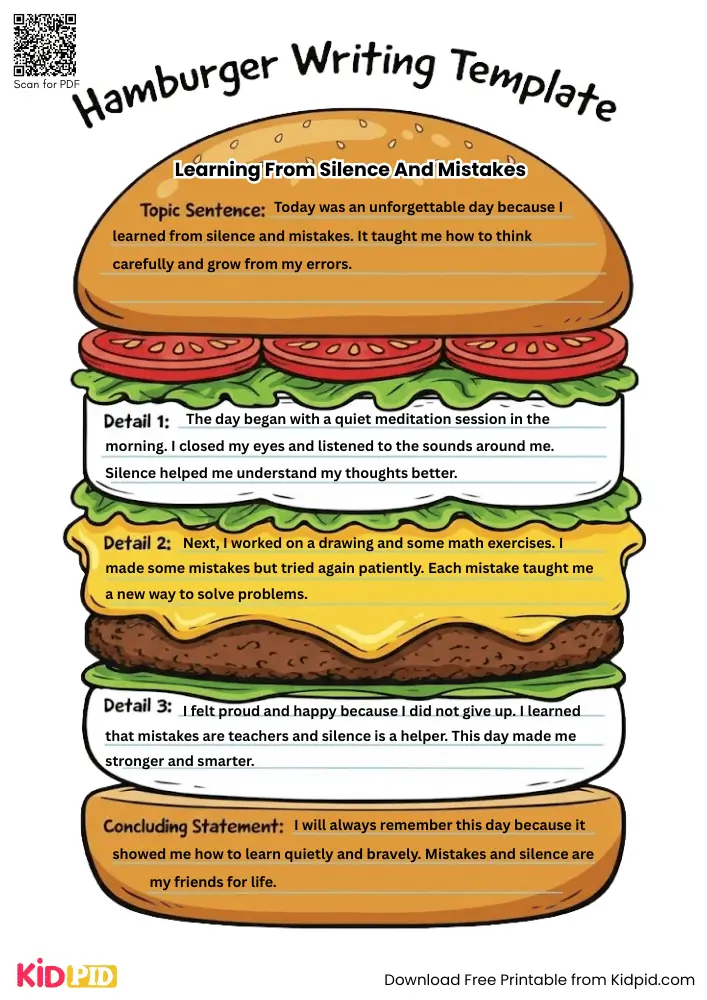
Topic Sentence: Today was an unforgettable day because I learned from silence and mistakes. It taught me how to think carefully and grow from my errors.
Details 1: The day began with a quiet meditation session in the morning. I closed my eyes and listened to the sounds around me. Silence helped me understand my thoughts better.
Details 2: Next, I worked on a drawing and some math exercises. I made some mistakes but tried again patiently. Each mistake taught me a new way to solve problems.
Details 3: I felt proud and happy because I did not give up. I learned that mistakes are teachers and silence is a helper. This day made me stronger and smarter.
Concluding Statement: I will always remember this day because it showed me how to learn quietly and bravely. Mistakes and silence are my friends for life.
Short Paragraph on ‘Learning from Silence and Mistakes’ – 50 Words for Grades 2 & 3
My aim is to learn from silence and mistakes. Silence helps me think and listen. Mistakes are not bad; they are teachers. They show me how to try again. I want to be brave, learn quietly, and grow stronger every time I get something wrong.
Long Paragraph on ‘Learning from Silence and Mistakes’ – 100 Words for Grade 4
My aim is to become a good learner from silence and from my mistakes. In quiet moments, I listen to my thoughts and the world around me. Mistakes are like friendly guides, not enemies. They tell me, “Try a different way!” I will not be afraid to fail. Each mistake teaches me something new and makes me smarter. By staying calm in silence and brave with my errors, I will grow kinder to myself and stronger in everything I do. I aim to keep trying, learning, and improving every single day.
‘Learning from Silence and Mistakes’ Essay Writing
‘Learning from Silence and Mistakes’ – 150 to 200 Words for Grades 5 to 7 Students
Imagine silence is like a peaceful, blank piece of paper. In all that quiet, you can finally hear your own amazing ideas and see your feelings clearly. It’s in these calm moments that you can figure out a tricky puzzle or notice the beautiful sound of birds singing outside. Silence isn’t empty; it’s full of learning!
Now, think of mistakes as bumpy roads on a fun adventure. When you stumble on a bump—like getting a math problem wrong or spilling some paint—it doesn’t mean the adventure is over. It means you’ve discovered a new challenge! That bump shows you what not to do next time. By fixing a mistake, you build a bridge over that bump, making your brain stronger. Every artist has painted outside the lines, and every scientist has had an experiment fizzle. They learned from the quiet of thinking and the mess of mistakes. So, welcome quiet times and don’t fear errors. Together, they are your superpower for becoming wiser, kinder, and more creative every single day!
‘Learning from Silence and Mistakes’ – 300 Words Essay for Grades 8 to 10 Students
Have you ever sat quietly and watched a ladybug crawl on a leaf, or listened to the soft pitter-patter of rain? That’s the power of silence. It’s not just about the absence of noise; it’s a special space where your mind can relax, explore, and grow. In silence, you can hear the heartbeat of curiosity. You might suddenly understand a story better, think of a brilliant idea for a drawing, or simply feel calm and happy. Silence is like a reset button for your busy brain, helping you learn more about yourself and everything around you.
Now, let’s talk about mistakes—those little (or big!) oops moments that might make you feel frustrated. Getting a low grade on a quiz, arguing with a friend, or missing the final shot in a game can feel terrible. But here’s a wonderful secret: mistakes are not stop signs; they are bright, flashing guideposts! They are the world’s way of teaching you. A mistake in a recipe teaches you about measurements. A mispronounced word teaches you how to speak correctly. Every time you fix an error, you are building a stronger, smarter version of yourself.
The magic happens when you use silence and mistakes as a team. After a mistake, instead of getting angry, find a quiet corner. In that silence, ask yourself: “What happened?” and “What can I do differently next time?” This turns a frown into a powerful learning plan. Did you know that the sticky note was invented by a scientist who made a “bad” weak glue? He learned from his “mistake” in the quiet of his lab!
So, brave explorers, embrace the quiet moments. Listen to them. And when you trip on a mistake, don’t hide it—investigate it! Celebrate the fact that you are trying new things. Your brain is a muscle, and both silence and mistakes are its best workouts. Together, they prepare you for all of life’s wonderful adventures, making you resilient, thoughtful, and ready to learn forever.
Related Essay & Paragraph Topics
- Silence and Mistakes: Our Quiet Teachers
- Lessons We Learn When We Pause and Fail
- How Silence and Mistakes Help Us Grow
- Learning Better Through Quiet Moments and Errors
- The Wisdom Hidden in Silence and Mistakes
You May like this:
Importance Of Completing Classwork Sincerely

Explains why completing classwork sincerely improves understanding and academic performance. Encourages dedication, responsibility, and disciplined study habits.
Importance Of Organizing School Supplies

Highlights how organizing school supplies improves productivity and time management. Encourages neatness, discipline, and efficient study habits.
How Punctuality Builds Discipline

Discusses how punctuality improves time management, responsibility, and reliability. Encourages disciplined routines and respect for time in school life.
Role Of Practice In Academic Success

Highlights how regular practice strengthens knowledge, skills, and academic performance. Encourages persistence, hard work, and effective learning habits.
Importance Of Classroom Cleanliness

Highlights how maintaining classroom cleanliness creates a healthy and productive learning environment. Encourages hygiene, responsibility, and respect for shared spaces.