Class participation helps children grow confident in a natural way. When students speak, ask questions, and share ideas, they learn to trust themselves. Taking part in classroom activities builds courage, improves learning, and helps children express thoughts clearly in school and everyday life.
5 Pointers on ‘Learning Confidence Through Class Participation’
- Speaking in class helps students feel brave and confident.
- Asking questions improves understanding and learning.
- Sharing ideas teaches students to express thoughts clearly.
- Class participation builds communication and listening skills.
- Regular participation helps students overcome fear and shyness.
‘Learning Confidence Through Class Participation’ Paragraph Writing
Hamburger Paragraph on ‘Learning Confidence Through Class Participation’ (Free Template)
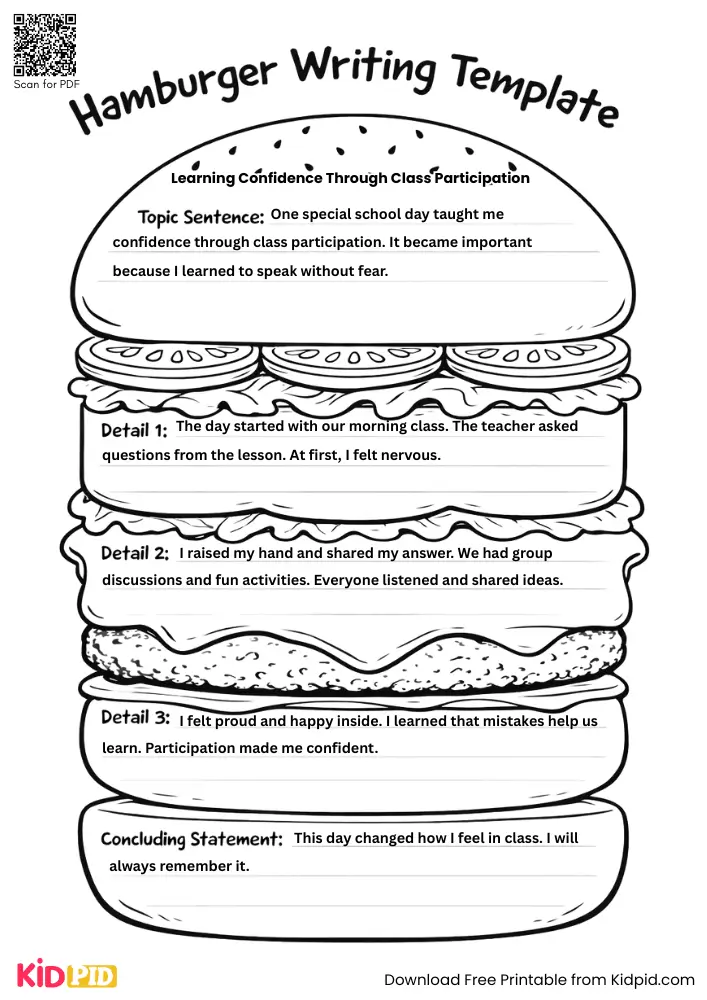
Topic Sentence: One special school day taught me confidence through class participation. It became important because I learned to speak without fear.
Details 1: The day started with our morning class. The teacher asked questions from the lesson. At first, I felt nervous.
Details 2: I raised my hand and shared my answer. We had group discussions and fun activities. Everyone listened and shared ideas.
Details 3: I felt proud and happy inside. I learned that mistakes help us learn. Participation made me confident.
Concluding Statement: This day changed how I feel in class. I will always remember it.
Short Paragraph on ‘Learning Confidence Through Class Participation’ – 50 Words for Grade 4
Class participation helps students become confident learners. When children speak, ask questions, or share ideas, they feel brave. Each small step builds confidence. Participating in class helps students learn better and express themselves without fear or hesitation.
Long Paragraph on ‘Learning Confidence Through Class Participation’- 100 Words for Grade 5

Class participation helps students build confidence step by step. When children answer questions or share ideas, they feel proud of themselves. Speaking in class helps them overcome fear and shyness. It also improves understanding of lessons. Group discussions teach teamwork and listening skills. Teachers’ encouragement makes students feel safe and valued. Making mistakes during participation is okay and helps learning. With regular participation, students become confident speakers and active learners. This confidence helps them succeed in school and in daily life.
‘Learning Confidence Through Class Participation’ Essay Writing
‘Learning Confidence Through Class Participation’- 150 to 200 Words Essay for Grades 6 to 8 Students
Have you ever felt a little butterfly in your tummy when the teacher asks a question? That’s your courage getting ready to grow! Class participation is like a superpower workout for your confidence.
Every time you raise your hand to answer a question or share an idea, you are telling yourself, “My voice is important.” It doesn’t matter if your answer is right or wrong. What matters is that you were brave enough to try. When you participate, your teacher and classmates listen. They learn from you, and you learn from them. This sharing makes the classroom a friendly team.
The more you practice speaking up, the quieter those tummy butterflies become. You start to feel stronger and prouder. You realize that you have smart things to say. So, take a deep breath and raise your hand. You are not just learning about math or science—you are learning the most important lesson of all: believing in yourself.
‘Learning Confidence Through Class Participation’ – 300 Words Essay for Grades 9 to 10 Students

Class participation is about much more than just giving the right answer; it is the primary training ground for one of life’s most important skills: self-confidence. Confidence isn’t something you are simply born with—it is built, piece by piece, through brave actions. Raising your hand in class is one of the most powerful ways to build it.
Firstly, participation transforms the classroom from a place where you only receive information into a place where you contribute. When you offer an idea, ask a question, or debate a point, you move from being a passive listener to an active learner. This active role proves to you, more than anyone else, that you are capable and that your perspective has value. Even when an answer is incorrect, the act of trying is a victory. It shows resilience and opens the door to understanding, teaching you that mistakes are not dead-ends but essential steps on the path to knowledge.
Secondly, a participating classroom creates a community of mutual support. When you courageously share your thoughts, you give permission for others to do the same. This builds an environment where it’s safe to take intellectual risks. You learn to articulate your thinking, defend your viewpoints, and listen respectfully to others—all skills that build social confidence.
Finally, the confidence you gain from speaking up in a familiar, supportive classroom doesn’t stay there. It travels with you. It helps you try out for the school play, make a new friend, or stand up for what’s right. Each time you participate, you are not just learning about history or grammar. You are practicing how to be a confident, engaged person. You are building the inner voice that says, “I have something to offer,” and that is a lesson that will help you succeed far beyond the classroom walls.
Related Essay & Paragraph Topics
- Building Confidence by Speaking in Class
- How Class Participation Shapes Confident Students
- From Shy to Confident
- Learning to Speak Up in the Classroom
- Confidence Grows When Students Participate
You May like this:
Balancing Online And Offline Life

Balancing online and offline life improves mental health, productivity, relationships, focus, and overall well-being.
Using Technology Wisely

Using technology wisely enhances productivity, innovation, learning, communication, digital responsibility, and balanced screen time.
Positive Use Of Social Platforms

Positive social platform use encourages meaningful connections, knowledge sharing, creativity, responsible engagement, and digital growth.
Building Good Digital Habits

Building good digital habits promotes cybersecurity, balanced usage, productivity, online etiquette, privacy protection, and healthy screen time.
Learning Adaptability

Adaptability builds resilience, flexibility, growth mindset, confidence, coping skills, and success in changing environments.