“Learning beyond textbooks opens the door to real-life understanding. Students explore, ask questions, and try activities that bring lessons to life. Nature, experiments, and hands-on projects make learning fun and meaningful. This approach builds skills, confidence, and curiosity, showing that education is more than books—it’s an exciting adventure every day.”
5 Pointers on ‘Learning Beyond Textbooks’
- Learning does not happen only from textbooks.
- We learn many things from real-life experiences.
- Activities, games, and projects help us understand better.
- Observing and asking questions improves learning.
- Learning beyond textbooks builds confidence and skills.
‘Learning Beyond Textbooks’ Paragraph Writing
Hamburger Paragraph on ‘Learning Beyond Textbooks’ (Free Template)
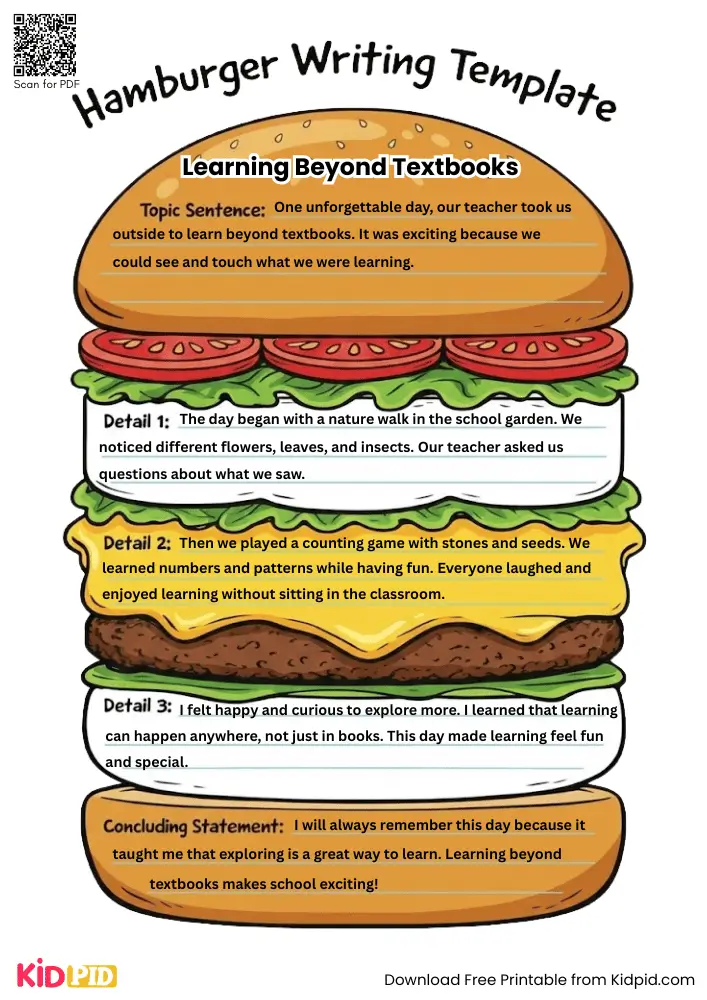
Topic Sentence: One unforgettable day, our teacher took us outside to learn beyond textbooks. It was exciting because we could see and touch what we were learning.
Detail 1: The day began with a nature walk in the school garden. We noticed different flowers, leaves, and insects. Our teacher asked us questions about what we saw.
Detail 2: Then we played a counting game with stones and seeds. We learned numbers and patterns while having fun. Everyone laughed and enjoyed learning without sitting in the classroom.
Detail 3: I felt happy and curious to explore more. I learned that learning can happen anywhere, not just in books. This day made learning feel fun and special.
Concluding Statement: I will always remember this day because it taught me that exploring is a great way to learn. Learning beyond textbooks makes school exciting!
Short Paragraph on ‘Learning Beyond Textbooks’ – 50 Words for Grades 3 to 4
Learning beyond textbooks helps us understand the real world. We learn from nature, activities, and daily life. Playing games, doing experiments, and asking questions make learning fun. This type of learning helps us think better and remember things for a long time.
Long Paragraph on ‘Learning Beyond Textbooks’ – 100 Words for Grade 5

Learning beyond textbooks is very important for students. Books give us knowledge, but real learning comes from experience. We learn by doing activities, playing games, and working on projects. Outdoor learning and experiments help us understand concepts clearly. We also learn from teachers, friends, and our surroundings. Asking questions and observing things makes us curious and confident. Learning beyond textbooks makes education fun and interesting. It helps us develop skills like teamwork, creativity, and problem-solving, which are useful in daily life.
‘Learning Beyond Textbooks’ Essay Writing
‘Learning Beyond Textbooks’ – 150 to 200 Words Essay for Grades 6 to 8 Students
While textbooks give us important facts and maps, the most exciting learning happens when we close the book and look at the world around us. True learning is an adventure that goes far beyond the classroom walls.
It happens when you plant a seed and watch it grow into a flower, learning about life cycles firsthand. It’s in the messy joy of mixing baking soda and vinegar to create a fizzy volcano, understanding chemistry through your own eyes and hands. It’s in listening to your grandparent’s childhood stories, which teach you about history and kindness in a way a timeline never could. Learning beyond textbooks means using all your senses—touching, building, asking, and exploring. It turns abstract ideas into real experiences, making knowledge stick with you forever. This kind of learning doesn’t just fill your head; it fuels your curiosity and shows you that education is a lively, endless discovery.
‘Learning Beyond Textbooks’ – 300 Words Essay for Grades 9 to 10 Students

Imagine if you learned about bicycles only by reading a manual but never got to ride one. You might know the parts’ names, but you’d miss the feeling of balance, the rush of wind, and the freedom of the open path. This shows why learning beyond our textbooks is so essential. Books provide the vital instructions and diagrams for life, but the real understanding comes from experience.
Our everyday life is packed with powerful lessons. When you help cook a meal, you’re practicing math through measurements and science through heat and fermentation. Building a fort from blankets and chairs teaches engineering and problem-solving. Arguing kindly with a sibling over rules for a game sharpens your communication and fairness. These are not just chores or play; they are the practical applications of knowledge. They answer the timeless question students often ask: “When will I ever use this in real life?”
Furthermore, the world is full of living teachers. A walk in the woods with a park ranger teaches ecology more vividly than any textbook photo. A visit to a historical monument makes the past feel immediate and real. Even talking to a shopkeeper or a farmer can give you insights into economics and community. This kind of learning builds empathy, creativity, and critical thinking—skills that are crucial for solving real-world problems.
Ultimately, learning beyond textbooks connects our heads to our hearts and hands. It transforms information into wisdom. It shows us that knowledge isn’t just something to be memorized for a test but a tool to be used for understanding, creating, and navigating the wonderful, complex world we live in. The greatest education happens when we stay curious, engage with our surroundings, and dare to learn by doing.
Related Essay & Paragraph Topics
- Learning Beyond Textbooks
- Education Outside the Classroom
- Learning from Life Experiences
- Why Practical Learning Matters
- Learning Through Activities and Experience
You May like this:
Learning Through Technology

This essay explains how technology supports modern learning through online classes, educational apps, digital resources, and interactive tools. Encourages students to use technology wisely for knowledge, creativity, and academic success.
Dangers of Fake Information

This essay highlights the dangers of fake information online and on social media. Teaches students to verify facts, think critically, avoid misinformation, and practice responsible internet usage.
Importance Of Online Discipline

This essay highlights the importance of online discipline, responsible internet use, respectful communication, and managing screen time. Encourages students to follow digital rules and maintain positive online behavior.
Positive Use Of Social Media

This essay explains how social media can be used positively for learning, sharing ideas, and building connections. Encourages responsible social networking and avoiding harmful online activities.
Smart Use Of Gadgets

This essay explains how students can use gadgets wisely for learning, creativity, and productivity. Encourages balanced screen time and responsible technology habits.