“Learning through experiments turns study time into an exciting journey of discovery. Children understand ideas better when they test, observe, and explore on their own. This hands-on learning builds curiosity, confidence, and thinking skills. Experiments make lessons lively, meaningful, and memorable, helping young minds enjoy learning while finding real answers.”
5 Pointers on “Learning through experiments”
- Experiments help us understand how things really work.
- They make learning fun and interesting.
- We can learn from mistakes and find better solutions.
- Experiments encourage curiosity and creativity.
- They teach problem-solving and critical thinking skills.
‘Learning through experiments’ Paragraph Writing
Hamburger Paragraph on ‘Learning through experiments’ (Free Template)
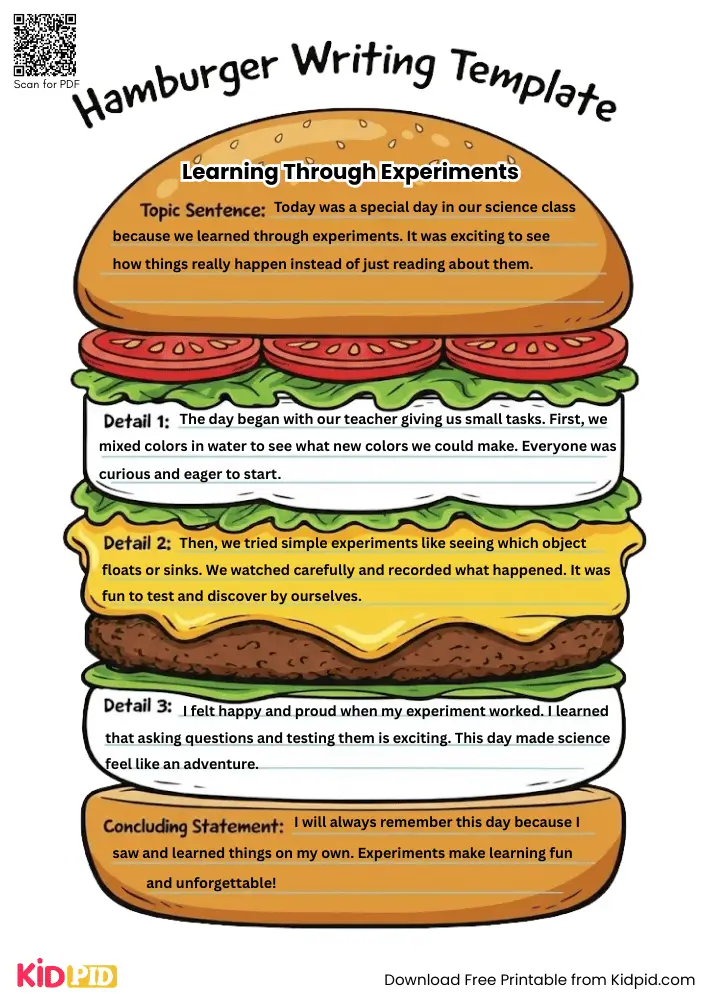
Topic Sentence: Today was a special day in our science class because we learned through experiments. It was exciting to see how things really happen instead of just reading about them.
Details 1: The day began with our teacher giving us small tasks. First, we mixed colors in water to see what new colors we could make. Everyone was curious and eager to start.
Details 2: Then, we tried simple experiments like seeing which object floats or sinks. We watched carefully and recorded what happened. It was fun to test and discover by ourselves.
Details 3: I felt happy and proud when my experiment worked. I learned that asking questions and testing them is exciting. This day made science feel like an adventure.
Concluding Statement: I will always remember this day because I saw and learned things on my own. Experiments make learning fun and unforgettable.
Short Paragraph on ‘Learning through experiments’ – 50 Words for Grade 3
Learning through experiments is fun! You get to mix, build, and watch what happens. It’s like being a detective. You ask a question, test your idea, and see the result. This hands-on way helps you understand big ideas easily. Science becomes a cool adventure you can touch!
Long Paragraph on ‘Learning through experiments’ – 100 Words for Grade 4
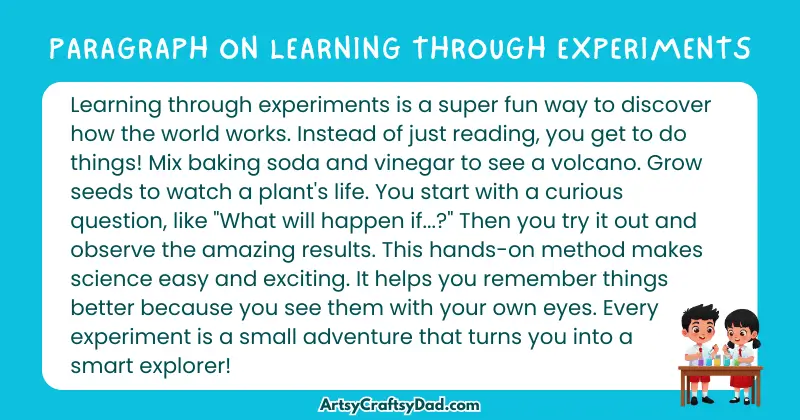
Learning through experiments is a super fun way to discover how the world works. Instead of just reading, you get to do things! Mix baking soda and vinegar to see a volcano. Grow seeds to watch a plant’s life. You start with a curious question, like “What will happen if…?” Then you try it out and observe the amazing results. This hands-on method makes science easy and exciting. It helps you remember things better because you see them with your own eyes. Every experiment is a small adventure that turns you into a smart explorer!
‘Learning through experiments’ Essay Writing
‘Learning through experiments’ – 150 to 200 Words Essay for Grades 5 to 7 Students
Imagine learning not just from books, but by doing! That’s what learning through experiments is all about. It’s like being a detective or an explorer on a mission to discover something new. Instead of just being told that plants need sunlight, you could try growing one bean sprout on a sunny windowsill and another in a dark cupboard. When you check back in a week, you’ll see the difference yourself! That exciting “Aha!” moment is yours.
Experiments make learning an adventure. They can be simple, like testing which toy car rolls fastest down a ramp or mixing baking soda and vinegar to make a volcano. The best part is that there are no wrong answers, only discoveries. If your experiment doesn’t turn out how you guessed, you’ve still learned something valuable. So, get curious, ask “What if…?” and try things out. The world is your laboratory, and every experiment makes you a smarter, more creative thinker!
‘Learning through experiments’ – 300 Words Essay for Grades 8 to 10 Students
Learning through experiments is one of the most powerful and exciting ways to understand the world around us. Think of it as the difference between being told a recipe and actually baking the cake yourself. When you perform an experiment, you move from a passive listener to an active investigator, which makes the knowledge stick with you much longer.
The real magic of experimental learning is that it shows you the process of how things work. In a textbook, you might read that warm air rises. But when you hold a light paper spiral over a warm radiator and watch it begin to spin, you witness the principle in action. This firsthand experience builds a deeper, more intuitive understanding. You’re not just memorizing a fact; you’re connecting with a real-world phenomenon.
Furthermore, experiments teach life skills that go far beyond science. They encourage curiosity and teach you to ask good questions. They require careful planning, patience, and observation. You learn to follow procedures step-by-step but also to think creatively when things don’t go as planned. A result that surprises you is often the most valuable, pushing you to ask “Why did that happen?” and plan a new experiment. This cycle of question, test, and observe is the very heart of how all great discoveries are made.
Importantly, this approach isn’t limited to a science lab. You can experiment in the kitchen by tweaking a recipe, in art by mixing different mediums, or even in social studies by simulating a historical event through role-play. Every time you try something new to see the outcome, you are experimenting. By embracing this hands-on, curious mindset, you stop being just a student of knowledge and become a creator of it, building confidence and critical thinking skills that will help you solve problems for the rest of your life.
Related Essay & Paragraph Topics
- The Joy of Learning Through Experiments
- How Experiments Make Science Fun
- Learning by Doing: The Power of Experiments
- Experiments in Everyday Life
- Why Hands-On Learning is Important
You May like this:
Why Manners Matter Everywhere
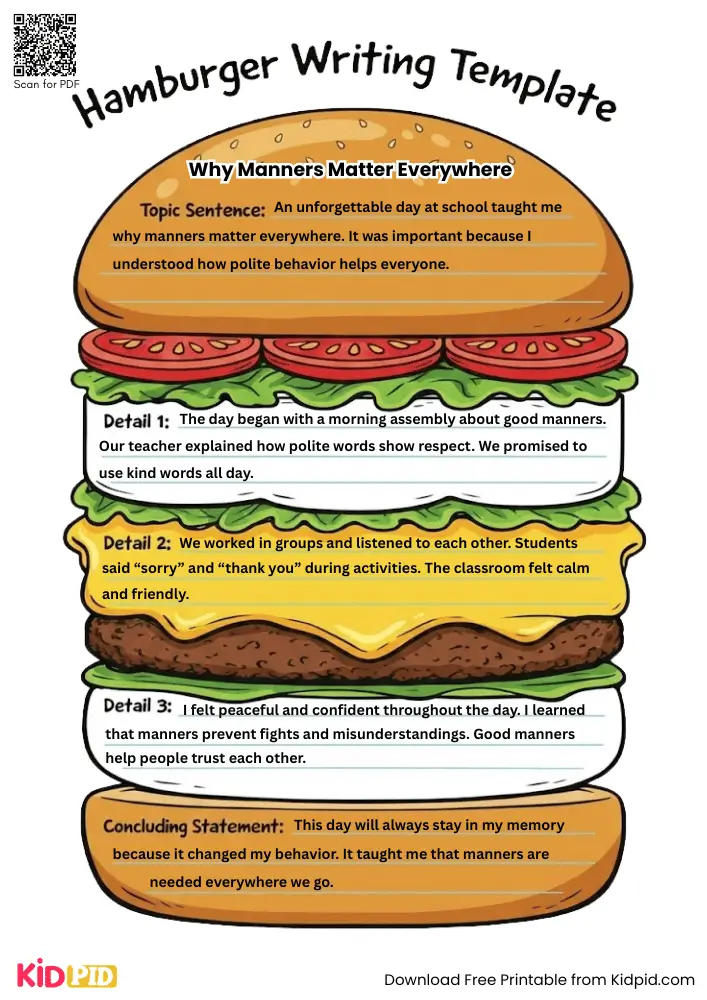
Learn why good manners create respect and positive impressions in school, home, and society. Promotes polite communication, social etiquette, kindness, and responsible behavior.
Value Of Patience In Life

Discover how patience helps overcome challenges and achieve long-term goals. Promotes perseverance, emotional balance, thoughtful decision-making, and personal success.
Being Kind Without Reason

Understand how unconditional kindness spreads happiness and positivity. Promotes compassion, empathy, generosity, and building meaningful relationships through simple acts of kindness.
Character Is Real Strength

Discover why strong character, honesty, and integrity define true strength. Encourages moral values, responsibility, self-discipline, and respectful behavior.
Learning Lessons From Daily Life
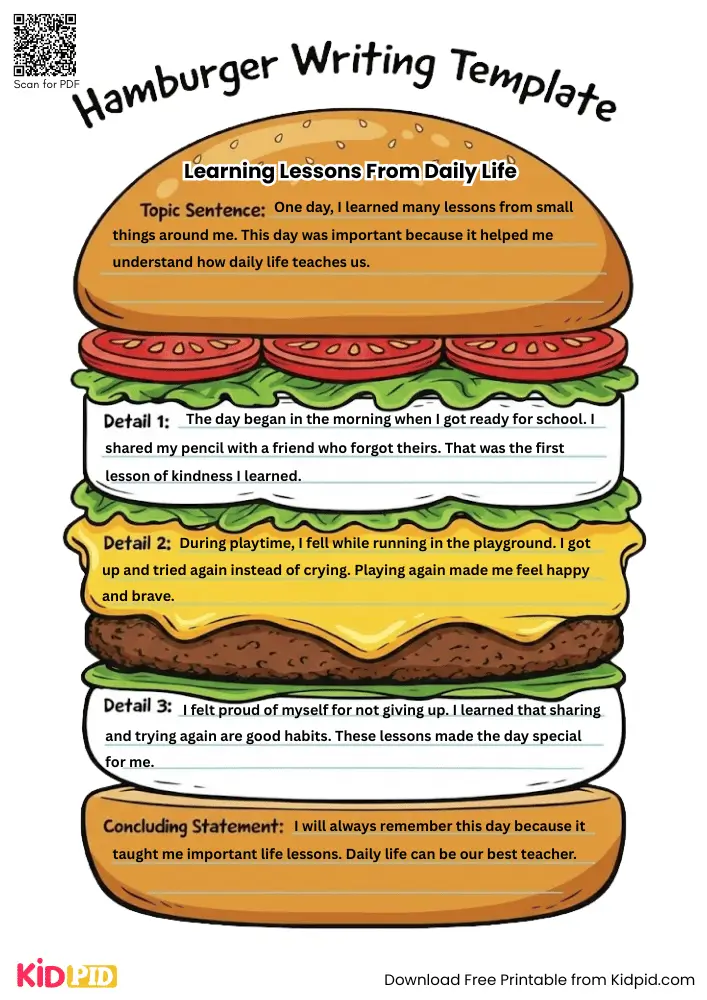
Explore how everyday experiences teach valuable life lessons. Encourages observation, reflection, practical learning, and personal growth through daily situations.