Learning to say no confidently helps children make safe and smart decisions. It teaches courage, self-respect, and independence. Children who say no politely can resist peer pressure, avoid unsafe situations, and stay responsible. This skill improves confidence, communication, and relationships, helping children grow into thoughtful, strong, and careful individuals.
5 Pointers on ‘Learning to Say No Confidently’
- Saying no confidently helps children set personal boundaries.
- It teaches children to make safe and healthy choices.
- Saying no politely shows self-respect and courage.
- It prevents peer pressure and unwanted situations.
- Learning to say no builds confidence, independence, and responsibility.
‘Learning to Say No Confidently’ Paragraph Writing
Hamburger Paragraph on ‘Learning to Say No Confidently’ (Free Template)

Topic Sentence: Today was a very important day because I learned how to say no confidently. It was unforgettable because it showed me how to stay true to myself and make smart choices.
Detail 1: The day began when a friend asked me to join a game that made me uncomfortable. I felt nervous and worried about saying no. Then I remembered that it’s okay to protect my feelings and make safe choices.
Detail 2: I took a deep breath and said, “I’m not comfortable with that, maybe another time.” My friend understood and suggested a different game we both enjoyed. I realized that saying no can be polite, clear, and respectful. Each time I practice saying no, I feel braver and stronger.
Detail 3: I felt proud and confident after saying no. I learned that my feelings and choices matter. This day became special because I discovered that saying no is not rude—it’s a superpower that helps me respect myself.
Concluding Statement: I will always remember this day because it taught me courage and self-respect. Saying no confidently will help me in school, at home, and with my friends for years to come.
Short Paragraph on ‘Learning to Say No Confidently’ – 50 Words for Grades 2 to 3
Learning to say no confidently means refusing something politely but firmly. It helps children stay safe, make smart choices, and respect themselves. Saying no shows courage and prevents problems caused by peer pressure. Children who say no confidently are more responsible, independent, and confident in school, at home, and in friendships.
Long Paragraph on ‘Learning to Say No Confidently’ – 100 Words for Grade 4
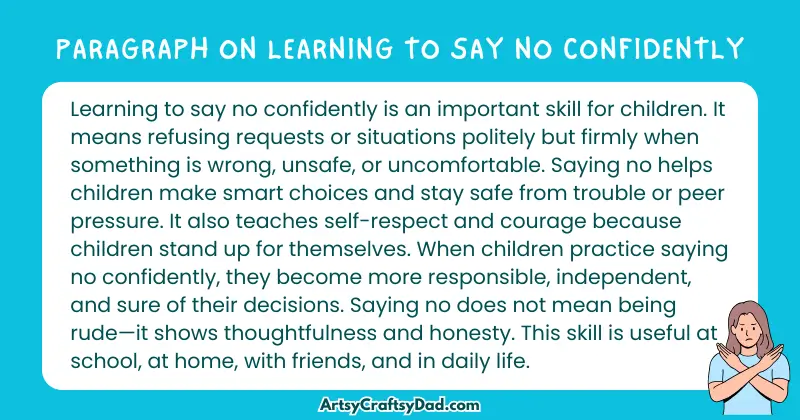
Learning to say no confidently is an important skill for children. It means refusing requests or situations politely but firmly when something is wrong, unsafe, or uncomfortable. Saying no helps children make smart choices and stay safe from trouble or peer pressure. It also teaches self-respect and courage because children stand up for themselves. When children practice saying no confidently, they become more responsible, independent, and sure of their decisions. Saying no does not mean being rude—it shows thoughtfulness and honesty. This skill is useful at school, at home, with friends, and in daily life.
‘Learning to Say No Confidently’ Essay Writing
‘Learning to Say No Confidently’ – 150 to 200 Words Essay for Grades 5 to 6 Students
Learning to say no confidently is a superpower that protects your time, energy, and feelings. It’s not about being mean or unhelpful; it’s about being honest and respectful to yourself and others. Imagine a friend asks you to play a game that makes you uncomfortable. A wobbly “okay” might lead to you feeling upset or unsafe. A confident “no, thanks” allows you to stay true to yourself.
Saying no confidently starts with knowing it’s your right. You are allowed to decide what you do with your body, your time, and your belongings. You can say no to a hug, to sharing something precious, or to joining an activity that feels wrong. Practice with a simple, polite phrase like, “I’m not comfortable with that,” or “I don’t want to.” You don’t need to invent a big excuse. A real friend will understand. Each time you say no to something you don’t want, you say a powerful “yes” to yourself, building self-respect and showing others how to treat you. It’s a key step in growing into a strong, independent person.
‘Learning to Say No Confidently’ – 300 Words Essay for Grades 7 to 8 Students
Learning to say no confidently is like building a friendly, strong fence around your personal garden. The garden is your time, your energy, your feelings, and your values. The fence isn’t to keep everyone out but to protect what’s inside so you can choose who and what you let in. This skill is essential because it teaches others how to treat you and, more importantly, teaches you to respect yourself.
Saying no is not about rejection; it’s about selection. It means you are thoughtfully choosing what deserves your “yes.” Perhaps you need to say no to an extra video game to say yes to your homework and a good night’s sleep. Maybe you need to say no to gossiping about a classmate to say yes to your value of kindness. A confident “no” is clear and polite. You can use phrases like “I’m going to pass this time” or “That doesn’t work for me.” You don’t owe a long, complicated story. Often, offering a brief reason can help: “No, I can’t trade lunches; I’m allergic to that.”
It’s normal to worry that people will be upset with you. But consider this: if someone only likes you when you always say yes, is that real friendship? True friends will respect your boundaries. Practicing with small things—like saying no to a second cookie—makes it easier for the big moments, like saying no to peer pressure. Stand tall, speak clearly, and remember that your comfort matters. Every confident “no” is a declaration that your thoughts and feelings are important. It is one of the bravest and most respectful things you can do—for yourself and for the people in your life.
Related Essay & Paragraph Topics
- The Power of Saying No Politely
- How Saying No Builds Confidence
- Learning to Stand Up for Yourself
- Saying No: A Skill for Safety and Respect
- How Children Can Make Smart Choices