“Discovering and understanding your surroundings is a fun way to learn about the world. By noticing people, animals, and nature, kids can stay safe and curious. Paying attention to sights, sounds, and changes around you helps you grow smarter, kinder, and more aware every single day.”
5 Pointers on “Understanding Surroundings”
- Pay attention to what is around you, like people, animals, and objects.
- Notice changes in your environment, such as weather, sounds, and smells.
- Be curious and ask questions about things you see and hear.
- Respect your surroundings by keeping them clean and safe.
- Learn from your surroundings to stay aware and make good decisions.
‘Understanding Surroundings’ Paragraph Writing
Hamburger Paragraph on ‘Understanding Surroundings’ (Free Template)

Topic Sentence: Today was a memorable day because I learned how to understand my surroundings. It helped me see and feel everything around me.
Details 1: The morning began with a walk around my neighborhood. I looked at the clouds and the colors of leaves. I listened to people talking and cars passing by.
Details 2: I touched the soft grass and smelled the fresh flowers. I watched birds flying and squirrels running. I even noticed small insects crawling around.
Details 3: I felt excited and curious about nature. I learned that noticing details helps me stay safe. The day became special because I explored carefully.
Concluding Statement: I will always remember this day because it taught me to observe. Understanding my surroundings makes the world an interesting place.
Short Paragraph on ‘Understanding Surroundings’ – 50 Words for Grade 3
Understanding your surroundings means knowing what is around you. Look at the sky, trees, and buildings. Listen to the birds and cars. Feel the sun or wind. Knowing your surroundings helps you stay safe. It also helps you learn about your neighborhood and the whole world.
Long Paragraph on ‘Understanding Surroundings’ – 100 Words for Grade 4
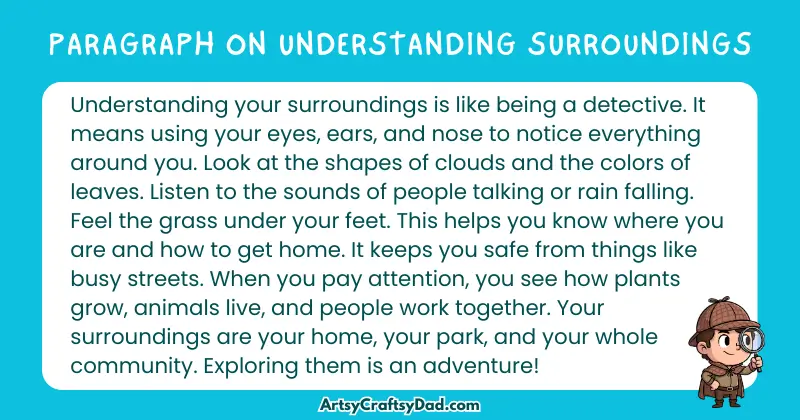
Understanding your surroundings is like being a detective. It means using your eyes, ears, and nose to notice everything around you. Look at the shapes of clouds and the colors of leaves. Listen to the sounds of people talking or rain falling. Feel the grass under your feet. This helps you know where you are and how to get home. It keeps you safe from things like busy streets. When you pay attention, you see how plants grow, animals live, and people work together. Your surroundings are your home, your park, and your whole community. Exploring them is an adventure!
‘Understanding Surroundings’ Essay Writing
‘Understanding Surroundings’ – 150 to 200 Words Essay for Grades 5 to 7 Students
Imagine your surroundings are like a giant, wonderful puzzle you get to solve every day. It’s not just your room or your school, but everything around you—the chattering squirrels in the park, the busy street with its honking cars, and even the weather changing the sky’s mood from bright blue to stormy grey. Understanding your surroundings means becoming a detective. You use your superpower senses to collect clues. You listen to the wind’s whisper, smell the earthy soil, and watch how a shadow moves with the sun.
When you start noticing these details, the world becomes less confusing and more fascinating. You see how the tall tree gives shade to the grass and a home to the birds. You realize that the signs and crosswalks are there to keep everyone safe. By paying attention, you learn how you are connected to it all. You learn that throwing trash in a bin helps your neighborhood, and a kind word can change a friend’s day. Understanding your surroundings helps you feel at home in your big, amazing world.
‘Understanding Surroundings’ – 300 Words Essay for Grades 8 to 10 Students
Have you ever stopped to think about what “surroundings” really mean? It’s like the stage for the play of your life. It includes everything that is around you right now, from the air you breathe and the floor under your feet to the people you talk to and the rules you follow. Understanding your surroundings is like learning the rules of a fantastic game. It helps you navigate your world safely, wisely, and happily.
First, it’s about safety and comfort. When you understand that a red light means “stop” and a hot stove can burn you, you protect yourself. Knowing where your library, playground, or a friend’s house is makes you feel secure and confident to explore. Just like you know where everything is in your bedroom, learning your neighborhood’s map makes the whole world feel more like home.
But it’s much more than just a map! It’s about seeing the hidden connections in nature and in our communities. In a garden, you might see a bee buzzing from flower to flower. By understanding, you learn that the bee isn’t just flying around—it’s collecting food and, at the same time, helping the flowers make seeds! That’s a connection. In your town, you see mail carriers, shopkeepers, and bus drivers. They are all connected parts of your surroundings, working together to help everyone.
Finally, understanding your surroundings shows you your own important role in it. You are not just watching the world go by; you are part of it! When you water a plant, you are helping nature. When you share your toys or say “thank you,” you are making your human surroundings kinder and brighter. Every piece of litter you pick up, every new friend you make, and every curious question you ask helps you understand and improve the wonderful, ever-changing puzzle that is your world. So, open your eyes, ears, and heart—your amazing surroundings are waiting to be discovered.
Related Essay & Paragraph Topics
- Observing Nature Around Us
- Learning from People and Society
- Awareness in Daily Life
- The Importance of Environmental Care
- Exploring New Places
You May like this:
Value Of Respect

Respect builds dignity, equality, and strong relationships. Treating others politely encourages harmony, cooperation, and trust while supporting inclusive communities and positive social interactions.
Importance Of Trust

Trust strengthens relationships, teamwork, and social harmony. Reliability, honesty, and consistency build confidence between individuals, improve cooperation, and create supportive environments essential for personal success and strong communities.
Learning Everywhere

Learning happens beyond classrooms through experiences, observation, and interactions. Staying curious in daily life improves knowledge, adaptability, creativity, and awareness while encouraging lifelong learning in every environment and situation.
Learning Through Practice

Practice builds mastery, confidence, and skill development. Repetition strengthens memory, improves performance, and promotes discipline while helping individuals achieve expertise, overcome weaknesses, and grow steadily through consistent effort.
Learning Through Mistakes

Mistakes provide valuable lessons, self-awareness, and improvement opportunities. Accepting errors helps build resilience, problem-solving skills, and growth mindset while encouraging continuous learning, confidence, and smarter decisions in future challenges.