Thinking about the future helps us make smart choices today. By imagining what lies ahead, setting goals, and planning carefully, we can be ready for challenges and opportunities. Developing future-oriented thinking teaches us to act wisely, dream big, and create a better life step by step.
‘Developing Future-Oriented Thinking’ Essay Writing
- Set Goals Early – Thinking about the future helps you set small and big goals in life.
- Plan Step by Step – Breaking tasks into smaller steps makes big dreams easier to achieve.
- Learn from Mistakes – Future thinking includes understanding past mistakes to make better choices.
- Stay Curious – Asking questions and learning new skills prepares you for challenges ahead.
- Think Positively – Imagining good outcomes motivates you to work hard and stay confident.
‘Developing Future-Oriented Thinking’ Paragraph Writing
Hamburger Paragraph on ‘Developing Future-Oriented Thinking’ (Free Template)
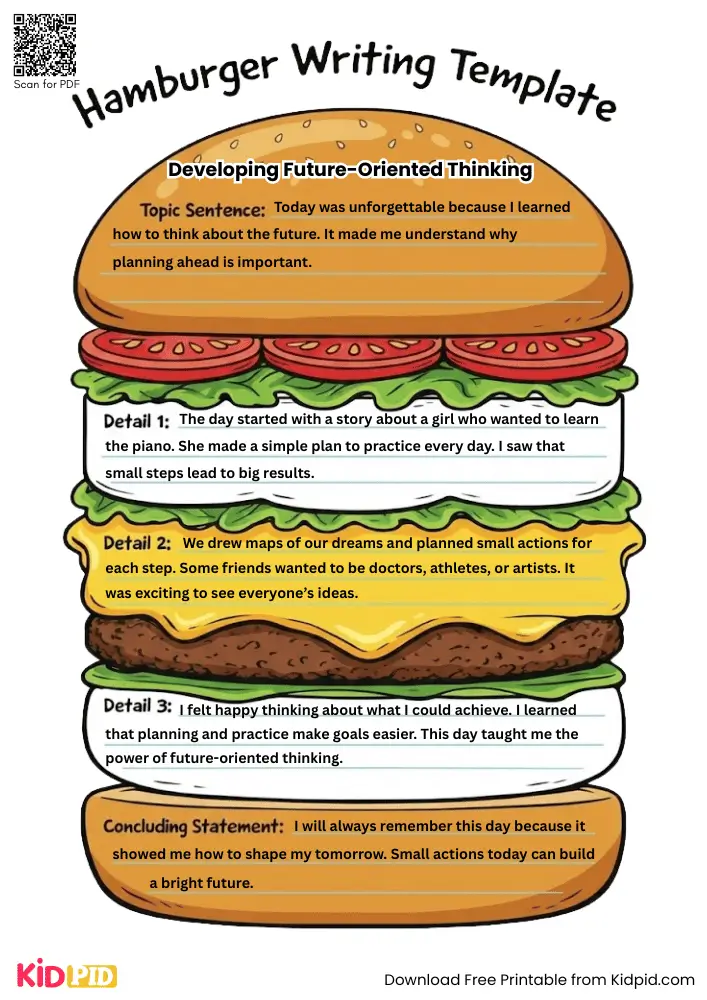
Topic Sentence: Today was unforgettable because I learned how to think about the future. It made me understand why planning ahead is important.
Details 1: The day started with a story about a girl who wanted to learn the piano. She made a simple plan to practice every day. I saw that small steps lead to big results.
Details 2: We drew maps of our dreams and planned small actions for each step. Some friends wanted to be doctors, athletes, or artists. It was exciting to see everyone’s ideas.
Details 3: I felt happy thinking about what I could achieve. I learned that planning and practice make goals easier. This day taught me the power of future-oriented thinking.
Concluding Statement: I will always remember this day because it showed me how to shape my tomorrow. Small actions today can build a bright future.
Short Paragraph on ‘Developing Future-Oriented Thinking’ – 50 Words for Grade 3
Future-oriented thinking is about planning ahead. It’s like planting a seed for a tree. You imagine what you want tomorrow. Then, you make small choices today to help it happen. Thinking ahead makes you feel ready and strong for anything the future brings.
Long Paragraph on ‘Developing Future-Oriented Thinking’ – 100 Words for Grade 4

Future-oriented thinking means using your imagination to see what comes next. It’s like being the captain of a ship, looking at the map to choose your course. You ask, “What do I want to be or do later?” Maybe get better at a sport or learn an instrument. Then, you make a simple plan. You practice a little each day. This kind of thinking helps you solve problems before they grow big. It turns big, scary goals into small, easy steps. When you think ahead, you build a bridge to your dreams, one smart brick at a time.
‘Developing Future-Oriented Thinking’ Essay
‘Developing Future-Oriented Thinking’ – 150 to 200 Words for Grades 5 to 7 Students
Imagine you have a superpower that lets you see into the future. You can’t really see tomorrow, but you can build it! That’s what future-oriented thinking is. It starts with a dream, like wanting to be an astronaut, a painter, or a planet-protector. But dreams need a bridge to reach them, and you build that bridge with the bricks you lay today.
When you plant a tiny seed and water it patiently, you’re thinking of the future flower. When you save a little of your allowance instead of spending it all, you’re planning for a bigger toy later. When you practice a skill, like reading or drawing, even when it’s hard, you are growing your future self. It also means thinking about how your choices affect others. Picking up litter helps the park stay clean for everyone next week. By imagining what could be, making small plans, and understanding that your actions matter, you become the architect of an amazing tomorrow. Your future starts with what you do right now!
‘Developing Future-Oriented Thinking’ – 300 Words Essay for Grades 8 to 10 Students
Have you ever watched a caterpillar? It’s a slow, munching little insect, but inside, it knows something incredible: it is meant to fly. It builds a chrysalis, a shell for the future, and transforms into a beautiful butterfly. You, too, have this amazing ability to grow and change for the future. This is called future-oriented thinking, and it’s like having a friendly time-traveler in your brain who helps you build a wonderful tomorrow.
First, it begins with your imagination. Close your eyes and picture yourself in five years. What are you doing? Maybe you’re coding a cool robot, playing in a sports championship, or helping in a community garden. This dream is your destination. But how do you get there? You make a map! If your dream is to be a great reader, your map says, “Read for 15 minutes every day.” These small, daily actions are the steps on your journey. Just like you can’t eat a whole pizza in one bite, you can’t reach a big goal in one day. You do it piece by piece, step by step.
Thinking about the future also means being a good detective for consequences. Every choice creates a ripple. If you finish your homework after school, the ripple is a relaxed evening and a happy teacher. If you share your toys, the ripple is a stronger friendship. By asking, “What will happen next?” you learn to make choices that create positive ripples for yourself and others.
Sometimes, you will face problems—a difficult math topic or a disagreement with a friend. Future-oriented thinkers see these not as roadblocks, but as training exercises. You learn to say, “How can I solve this?” This turns you into a creative problem-solver, which is a superpower everyone needs for the future.
Remember, the future isn’t a mysterious land that just happens to you. It is a garden, and you are the gardener. The seeds you plant today—kindness, hard work, curiosity, and responsibility—will grow into the trees that give you shade and fruit tomorrow. So, dream big, plan small, act kindly, and watch as you build your own brilliant future, starting right now
Related Essay & Paragraph Topics
- The Importance of Planning Ahead for Success
- How Future-Oriented Thinking Shapes Our Decisions
- A Key to a Bright Future
- Learning from Today to Build Tomorrow
- The Role of Imagination and Vision in Personal Growth
You May like this:
Value Of Understanding Others

Understanding others promotes empathy, tolerance, and strong social relationships. Listening to different perspectives builds emotional intelligence and encourages respectful communication in diverse communities.
Learning Discipline In Public Places

Discipline in public places encourages respect for rules, cleanliness, and responsible behavior. Good public conduct supports community order, safety, and shared social responsibility.
Importance Of Honesty In Society

Honesty builds trust, integrity, and transparency in society. Truthful communication strengthens relationships, supports ethical behavior, and promotes fairness and accountability.
Why Empathy Improves Relationships

Empathy helps people understand others’ feelings and perspectives. Compassion, emotional intelligence, and supportive behavior strengthen friendships, family bonds, and community relationships.
Value Of Responsible Actions

Responsible actions show accountability, reliability, and good citizenship. Making thoughtful decisions helps protect community interests and strengthens trust within society.