School uniforms are an important topic in education today. Many believe uniforms promote equality, discipline, and school identity among students. Wearing uniforms reduces distractions, builds a sense of belonging, and creates a focused learning environment, while also helping students develop responsibility, unity, and respect within the school community.
5 Pointers on “Should Students Wear Uniforms?”
- Uniforms make students feel equal, lowering pressure to follow fashion trends.
- They simplify mornings by removing outfit decisions.
- Wearing the same colors and logo builds pride and school unity.
- Fewer fashion distractions help students focus on learning and friends.
- Uniforms teach dressing appropriately, preparing for jobs, and activities.
‘Should Students Wear Uniforms?’ Paragraph Writing
Hamburger Paragraph on ‘Should Students Wear Uniforms?’ (Free Template)
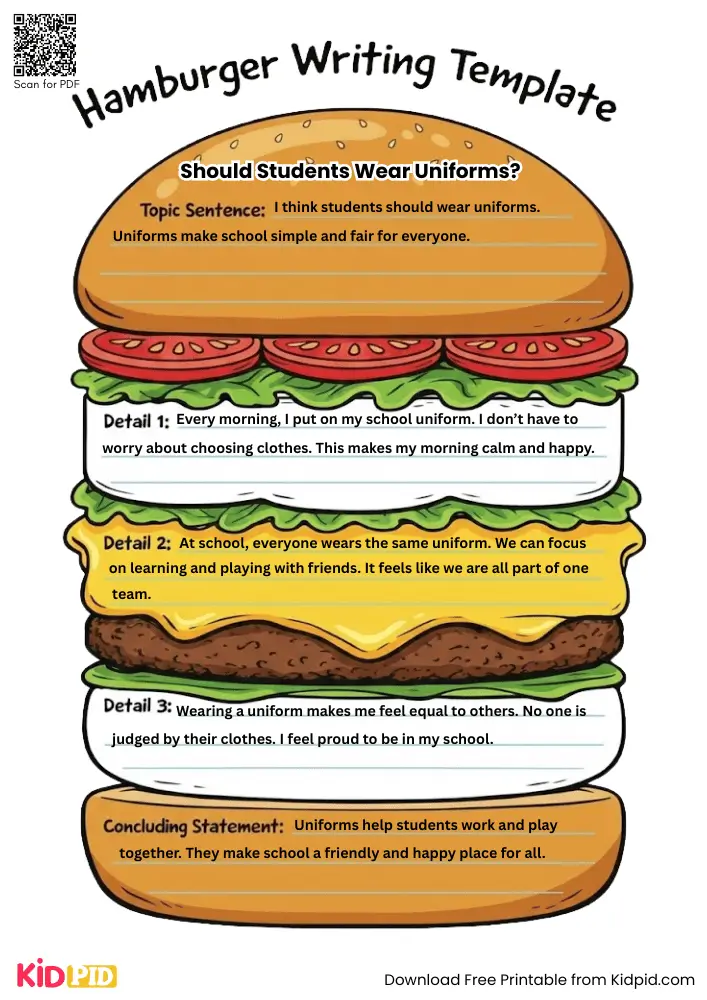
Topic Sentence: I think students should wear uniforms. Uniforms make school simple and fair for everyone.
Details 1: Every morning, I put on my school uniform. I don’t have to worry about choosing clothes. This makes my morning calm and happy.
Details 2: At school, everyone wears the same uniform. We can focus on learning and playing with friends. It feels like we are all part of one team.
Details 3: Wearing a uniform makes me feel equal to others. No one is judged by their clothes. I feel proud to be in my school.
Concluding Statement:
Uniforms help students work and play together. They make school a friendly and happy place for all.
Short Paragraph on ‘Should Students Wear Uniforms?’ – 50 Words Grades 1 to 2
School uniforms are a good idea. They make mornings easy. Everyone looks the same, so no one feels left out. You don’t worry about clothes, just about learning and playing with friends. Uniforms make school feel like one big team where everyone belongs.
Long Paragraph on ‘Should Students Wear Uniforms?’ – 100 Words for Grade 3

Should students wear uniforms? Many think yes. Uniforms make school fair. No one is judged by their clothes. Mornings are simpler because you always know what to wear. This saves time and stress. Uniforms also build school spirit. When everyone dresses alike, it feels like being on a team. You can show your style after school or on weekends. At school, the focus is on learning, not fashion. Uniforms help everyone feel equal and ready to learn together. They create a friendly and focused place for all students.
‘Should Students Wear Uniforms?’ Essay Writing
‘Should Students Wear Uniforms?’ – 150 to 200 Words Essay for Grades 4 to 6 Students
Should students wear school uniforms? It’s a big question! Many schools say yes, and here’s why. First, uniforms make mornings easy. You don’t have to stare at your closet deciding what to wear—you just put on your uniform and go! This saves time and energy for more important things, like eating a good breakfast. Second, uniforms help everyone feel like they belong to the same school family. When we all wear the same colors, it builds team spirit and pride, just like players on a sports team. Most importantly, uniforms can help students focus on what really matters: learning and friendship. Without worrying about who has the coolest jeans or newest sneakers, the classroom becomes a place where everyone is equal. Clothes don’t define us; our character and ideas do. While some miss showing their personal style, many find that uniforms create a sense of fairness and community. So, uniforms aren’t just about clothes; they’re about creating a positive and focused environment where every student can shine.
‘Should Students Wear Uniforms?’– 300 Words Essay for Grades 7 to 9 Students

Imagine your school as a big team. Just like soccer players wear jerseys or astronauts wear spacesuits, many students wear school uniforms. But is this a good idea? Let’s explore both sides.
The biggest reason for uniforms is that they create a sense of equality and belonging. When everyone wears the same outfit, it’s harder to judge someone based on their clothes or how much money their family has. This can reduce bullying and make the school feel safer and more welcoming for everyone. You are seen for who you are—your smile, your kindness, and your ideas—not for what you wear. Uniforms also take the daily stress out of choosing an outfit. This means less arguing in the morning and more time to sleep, eat, or review for a test! It helps students focus their energy on learning, playing, and building friendships instead of fashion competitions. Furthermore, uniforms teach us about dressing for a purpose. Just as you wear a swimsuit to the pool, you wear a uniform to school. This prepares you for the future, where many jobs, from chefs to firefighters, have special uniforms or dress codes.
On the other hand, some people argue that uniforms limit self-expression. Our clothes can be a fun way to show our unique personalities, like wearing a favorite color or a T-shirt from a cool place we visited. Without this choice, some students might feel a bit less like themselves. However, many schools allow for expression in other ways, like through hairstyles, accessories, or the artwork and projects you create.
In the end, school uniforms have many benefits. They promote fairness, save time, build school pride, and help everyone focus on being part of a learning community. While showing our personal style is fun, there are plenty of other times to do that—on weekends, after school, and at home. The main goal of school is to learn and grow together, and uniforms can help make that environment positive and equal for all students, letting every child’s true self shine through.
Related Essay & Paragraph Topics
- The Importance of School Uniforms
- Pros and Cons of Wearing School Uniforms
- How School Uniforms Promote Equality
- School Uniforms and Student Discipline
- Are School Uniforms Necessary in Modern Education?
You May like this:
Learning Financial Awareness

Financial awareness teaches budgeting, saving, investment planning, responsible spending, economic literacy, and long-term security.
Learning Independence

Independence builds confidence, responsibility, decision-making skills, self-reliance, maturity, and personal growth.
Learning Cooperation

Cooperation fosters teamwork, respect, shared responsibility, harmony, collaboration, and success.
Helping Elderly People

Helping elderly people shows compassion, respect, social responsibility, kindness, and community care.
Importance Of Social Harmony

Social harmony encourages peace, unity, tolerance, respect, diversity, and stable communities.