“Handling disappointment is an important life skill that helps children grow stronger through challenges. When plans fail or expectations are not met, learning to respond calmly builds patience and confidence. By understanding feelings and trying again, students develop resilience, positive thinking, and emotional strength for future success.”
5 Pointers on ‘Handling Disappointment’
- Disappointment is a feeling we get when things do not go as planned.
- It is okay to feel sad or upset sometimes.
- Talking about disappointment helps us feel lighter.
- Staying calm helps us think of better solutions.
- Handling disappointment makes us stronger and more confident.
‘Handling Disappointment’ Paragraph Writing
Hamburger Paragraph on ‘Handling Disappointment’ (Free Template)
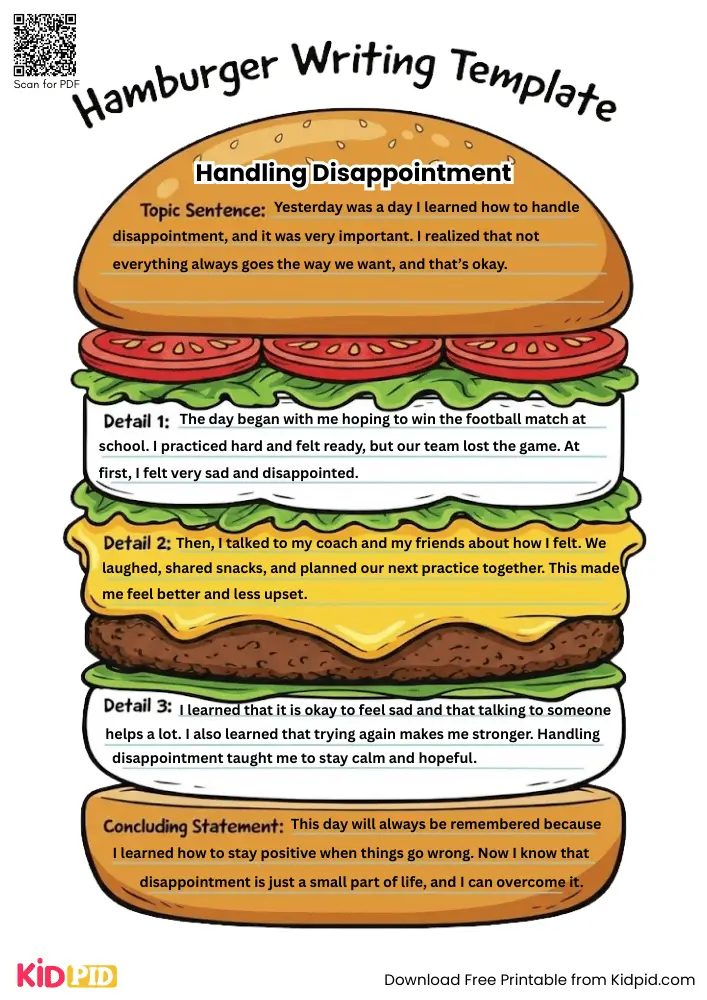
Topic Sentence: Yesterday was a day I learned how to handle disappointment, and it was very important. I realized that not everything always goes the way we want, and that’s okay.
Details 1: The day began with me hoping to win the football match at school. I practiced hard and felt ready, but our team lost the game. At first, I felt very sad and disappointed.
Details 2: Then, I talked to my coach and my friends about how I felt. We laughed, shared snacks, and planned our next practice together. This made me feel better and less upset.
Details 3: I learned that it is okay to feel sad and that talking to someone helps a lot. I also learned that trying again makes me stronger. Handling disappointment taught me to stay calm and hopeful.
Concluding Statement: This day will always be remembered because I learned how to stay positive when things go wrong. Now I know that disappointment is just a small part of life, and I can overcome it.
Short Paragraph on ‘Handling Disappointment’ – 50 Words for Grades 3 to 4
Handling disappointment means staying calm when things go wrong. It is okay to feel sad sometimes. Talking to parents or friends helps. Trying again instead of giving up makes us stronger. Handling disappointment helps children stay confident and hopeful in difficult situations.
Long Paragraph on ‘Handling Disappointment’ – 100 Words for Grade 5
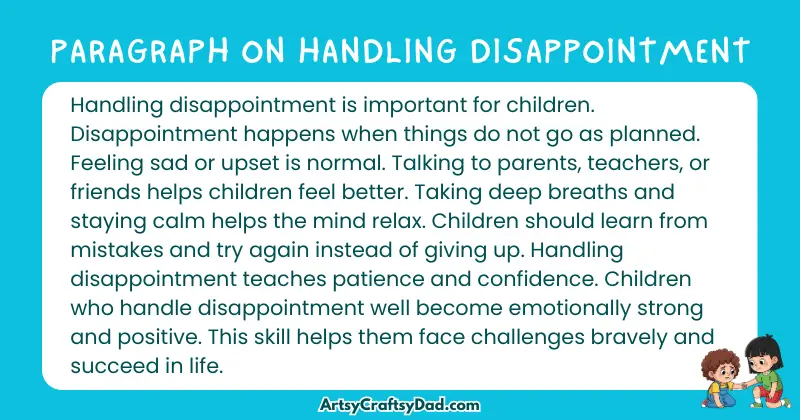
Handling disappointment is important for children. Disappointment happens when things do not go as planned. Feeling sad or upset is normal. Talking to parents, teachers, or friends helps children feel better. Taking deep breaths and staying calm helps the mind relax. Children should learn from mistakes and try again instead of giving up. Handling disappointment teaches patience and confidence. Children who handle disappointment well become emotionally strong and positive. This skill helps them face challenges bravely and succeed in life.
‘Handling Disappointment’ Essay Writing
‘Handling Disappointment’ – 150 to 200 Words Essay for Grades 6 to 8 Students
Disappointment is a heavy, sinking feeling, like when you build a tall tower and it suddenly falls. Everyone feels it, from not making the team to a cancelled playdate. Handling disappointment doesn’t mean you shouldn’t feel sad; it means learning how to pick up the pieces and feel better.
First, be kind to yourself. It’s okay to cry or say, “This really stinks!” Let yourself feel the disappointment instead of pretending it doesn’t hurt. Talking to someone who cares can help a lot—they can give you a hug and help you see things clearly. Then, try to look forward. Ask yourself, “What’s my next move?” Maybe you can practice more for next season’s tryouts or plan a special game night to replace the cancelled plans. Finally, do something that brings you joy, like playing with your pet or drawing a picture. Disappointment is a rain shower, but it doesn’t last forever. By handling it bravely, you learn that you are strong enough to weather the storm and find the sunshine again.
‘Handling Disappointment’ – 300 Words Essay for Grades 9 & 10 Students

Handling disappointment is like finding your balance after a stumble. That sudden, shaky feeling when things don’t go your way is completely normal. The goal isn’t to avoid ever stumbling—that’s impossible—but to learn how to catch yourself, dust off, and keep walking with resilience.
The first and most important step is to acknowledge the fall. Pretending you aren’t disappointed is like ignoring a scraped knee; it won’t help it heal. Give yourself permission to feel sad, frustrated, or even angry for a little while. These feelings are honest messengers telling you that something mattered to you. It can be helpful to express them by talking to a trusted adult, writing in a journal, or even drawing a picture of how you feel. This gets the emotion out of your heart and into the open, where it’s less overwhelming.
Once the initial sting softens, you can begin the work of understanding the stumble. Look at what happened with gentle curiosity, not anger. Was there something you could learn? Perhaps you discover you need more practice, or that you need a backup plan. This isn’t about blame but about gathering useful information for next time. Disappointment often points our attention in a new direction, like a signpost we didn’t notice before.
Finally, take a small, positive step forward. Do something that reminds you of your own capability and joy—help a sibling, master a video game level, or lose yourself in a great book. Action is the antidote to feeling stuck. By moving forward, you prove to yourself that disappointment is a chapter in your story, not the whole book. Handling it well builds a quiet, inner confidence, showing you that you are stronger than any single setback.
Related Essay & Paragraph Topics
- Learning to Handle Disappointment
- Importance of Handling Disappointment
- Staying Calm During Disappointment
- Turning Disappointment into Strength
- Handling Failure Positively
You May like this:
Importance Of Learning From Challenges

Challenges provide learning opportunities that improve resilience, problem-solving abilities, and personal development.
How Problems Strengthen Mindset
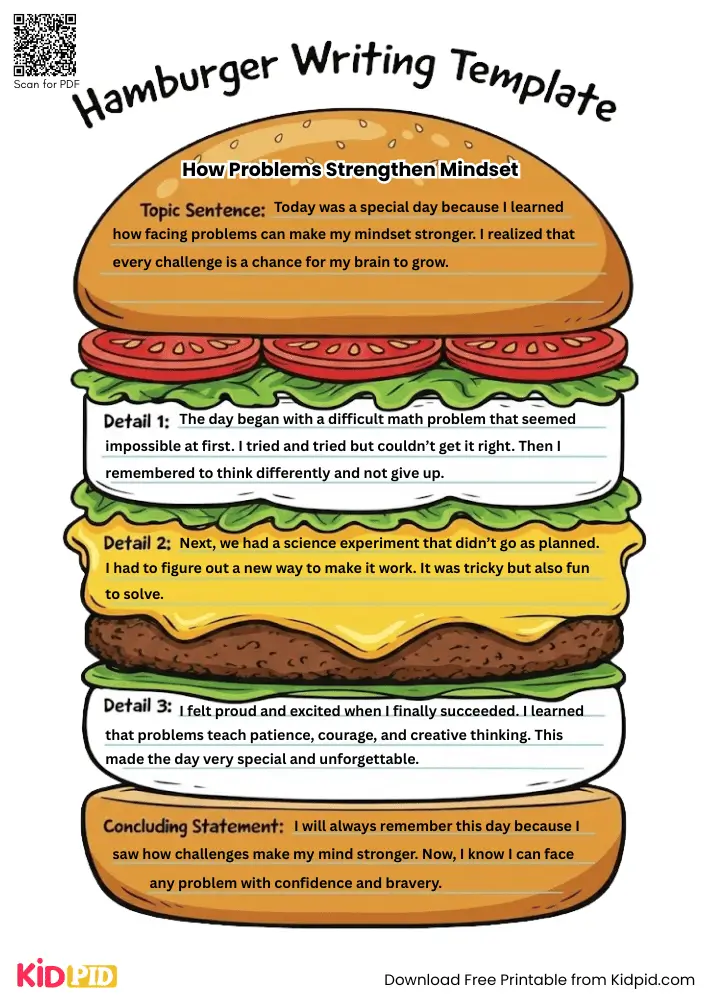
Problems strengthen mindset by developing resilience, patience, and confidence to overcome future challenges.
Learning Problem-Solving Through Experience

Experience teaches valuable problem-solving skills, improving judgment, creativity, and confidence in handling challenges.
Importance Of Flexible Thinking

Flexible thinking allows individuals to adapt ideas, consider new perspectives, and find effective solutions.
How Obstacles Teach Creativity

Obstacles encourage creative thinking, innovation, and alternative solutions that improve problem-solving abilities.