Imagine a school on the Moon where students study under low gravity and see Earth from the sky. Classes would be exciting, with space science, astronauts as teachers, and rockets as school buses. This topic encourages creativity and curiosity while helping students imagine learning in space and exploring how education might look beyond our planet.
5 Pointers on “Imagine School on the Moon.”
- The school would float because there is very low gravity on the Moon.
- Students would travel to school in rockets instead of buses.
- Classrooms would be inside big glass domes to stay safe.
- Children would wear space suits to play outside during recess.
- Teachers would teach about space, planets, and stars every day.
‘Imagine School on the Moon’ Paragraph Writing
Hamburger Paragraph on ‘Imagine School on the Moon’ (Free Template)
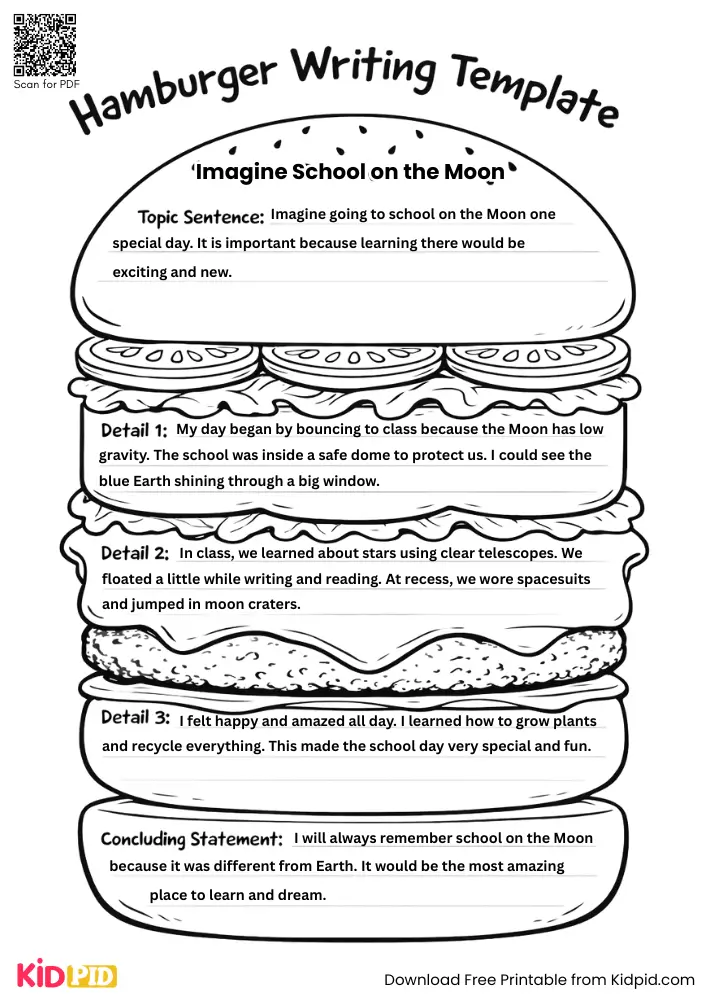
Topic Sentence: Imagine going to school on the Moon one special day. It is important because learning there would be exciting and new.
Details 1: My day began by bouncing to class because the Moon has low gravity. The school was inside a safe dome to protect us. I could see the blue Earth shining through a big window.
Details 2: In class, we learned about stars using clear telescopes. We floated a little while writing and reading. At recess, we wore spacesuits and jumped in moon craters.
Details 3: I felt happy and amazed all day. I learned how to grow plants and recycle everything. This made the school day very special and fun.
Concluding Statement: I will always remember school on the Moon because it was different from Earth. It would be the most amazing place to learn and dream.
Short Paragraph on ‘Imagine School On The Moon’ – 50 Words for Grades 2 & 3
Imagine school on the Moon! You would bounce to class in low gravity. See Earth in the black sky. Wear a spacesuit for recess to jump in craters. Learn by studying stars up close. It would be a fun and amazing place to learn every day.
Long Paragraph on ‘Imagine School on the Moon’ – 100 Words for Grade 4

Imagine going to school on the Moon! Your classroom is inside a safe dome. You bounce everywhere because gravity is low. Through a giant window, you see the beautiful blue Earth shining in space. For recess, you wear a fun spacesuit. Outside, you can take huge jumps over moon dust. You learn special things. Study the stars with clear telescopes. Grow plants in a science lab. Learn to recycle everything. Every day is a new space adventure. School on the Moon would be the most exciting and floaty place to learn!
‘Imagine School on the Moon’ Essay Writing
‘Imagine School on the Moon’ – 150 to 200 Words Essay for Grades 5 to 7 Students
Imagine going to school on the Moon! Your school day would start with a fantastic bounce to class because of the Moon’s low gravity. In your classroom, you might float to the whiteboard or do a slow-motion somersault to reach your desk. For science lessons, you could look through a giant telescope at the sparkling stars and planets, which appear brighter and clearer than from Earth. The best part? The huge window in your classroom would show the beautiful blue Earth hanging in the black sky like a giant marble.
Recess would be the most amazing adventure. You’d put on your own spacesuit and hop outside to play. You could take enormous leaps over moon dust and see who can jump the highest in a crater. You might even help collect special rocks for a project. At a moon school, you would also learn important things like how to grow plants in a lab and how to use every drop of water. Going to school on the Moon would be a fun, floaty, and incredible way to learn!
‘Imagine School on the Moon’ – 300 Words Essay for Grades 8 to 10 Students

Picture this: your school bus is a sleek lunar rover, and your school is a shiny, dome-shaped building on the quiet, gray surface of the Moon. Welcome to your new school day! Because the Moon has less gravity than Earth, everything about moving is more fun. You wouldn’t walk down the hall—you’d bounce or float in gentle, slow leaps. During P.E., playing basketball or tag would be a hilarious, floaty challenge where everyone can jump like a superhero.
Your lessons would be out of this world—literally! In science class, you could study the universe through powerful telescopes. With no clouds or busy atmosphere in the way, the stars and planets would look incredibly bright and close. You might even track satellites or watch a meteor shower up close. Your classroom would have the best view imaginable: our home planet, Earth, shining blue and white in the eternal night sky. You could learn geography just by looking at it!
Recess is an adventure that needs a spacesuit. After carefully getting suited up, you’d hop outside to explore. You could make giant leaps in a moon crater, seeing how high you can go, or have contests for the slowest, most graceful somersault. You might help your class collect different types of moon rocks and dust to study later. Back inside, you’d learn how to be a great space citizen. This means understanding how to grow vegetables in a special garden lab using artificial sunlight and how to recycle every single thing, even the air you breathe. A school on the Moon would teach you amazing facts about space and also how to take care of your unique home. It would be a place of endless wonder, where every day is a giant leap for learning.
Related Essay & Paragraph Topics
- A Day at My Moon School
- Learning Among the Stars
- Life as a Moon Student
- Adventures in a Lunar Classroom
- Fun and Friends on the Moon
You May like this:
Preserving Natural Beauty

Preserving landscapes, forests, and rivers protects biodiversity and tourism value. Conservation efforts maintain ecological balance and environmental heritage.
Thinking Beyond Limits
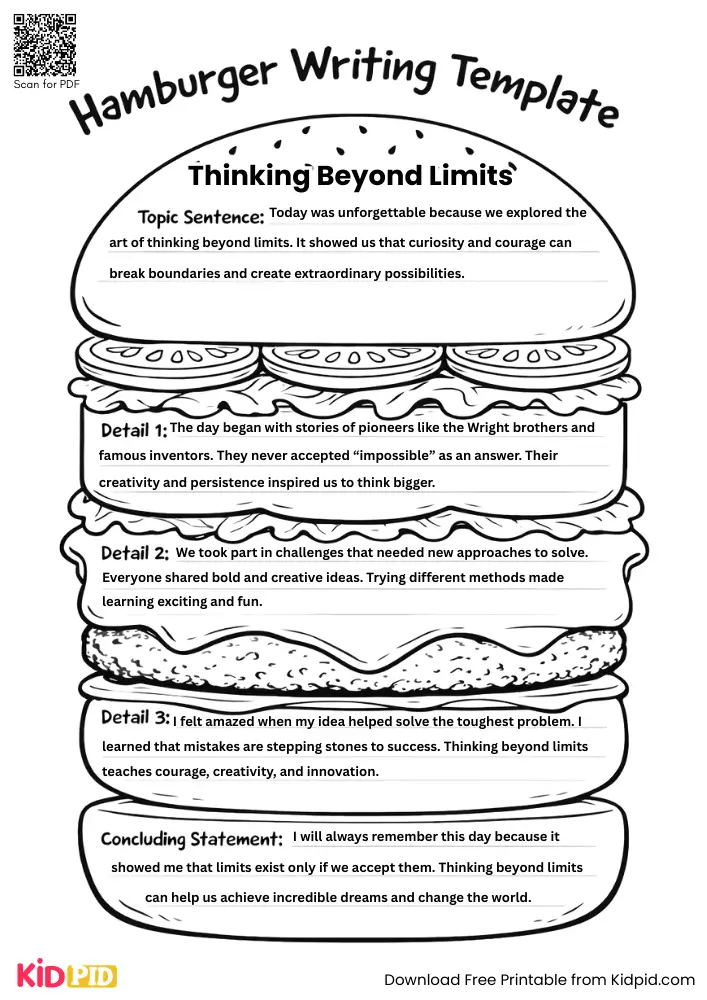
Limitless thinking inspires creativity, innovation, and growth. Challenging boundaries, exploring ideas, and embracing possibilities help individuals achieve success and discover new opportunities.
Creative Problem-Solving

Creative solutions improve innovation, adaptability, and efficiency. Thinking differently, analyzing situations, and exploring alternatives help individuals overcome challenges while encouraging flexibility, critical thinking, and practical success.
Thinking Differently

Different thinking sparks innovation, creativity, and progress. Challenging assumptions, exploring new perspectives, and embracing originality help individuals discover unique solutions and opportunities for growth.
Creativity In Daily Life

Creativity improves problem-solving, productivity, and joy. Using imagination in everyday tasks encourages innovation, flexibility, and fresh thinking while making life more engaging and meaningful.