“The world is full of amazing things waiting to be discovered! By exploring nature, meeting new people, and reading books, kids can learn how everything works. Curiosity helps you ask questions, see new places, and understand cultures. Learning about the world makes life exciting, fun, and full of wonder.”
5 Pointers on “Learning About The World”
- Exploring nature helps us understand animals, plants, and the environment.
- Traveling to new places teaches us about different cultures and traditions.
- Reading books and using the internet can give us knowledge about history and science.
- Meeting new people helps us learn different languages, ideas, and ways of life.
- Observing our surroundings encourages curiosity and problem-solving skills.
‘Learning About The World’ Paragraph Writing
Hamburger Paragraph on ‘Learning About The World’ (Free Template)

Topic Sentence: One school day became unforgettable when I started learning deeply about the world. It was important because it taught me how learning happens everywhere.
Details 1: The day began with observing nature around our school. We watched insects and talked about how plants grow. This helped us learn through real experiences.
Details 2: Later, we read books and discussed different countries and cultures. I enjoyed learning about food, music, and languages from around the world. Each activity felt exciting and new.
Details 3: I felt inspired and curious throughout the day. I learned that mistakes help us understand better. The day became special because I learned by exploring.
Concluding Statement: This day will always be remembered as a learning adventure. It showed me that the world is full of lessons.
Short Paragraph on ‘Learning About The World’ – 50 Words for Grades 2 & 3
Learning about the world is a fun adventure! You can read books, watch documentaries, and look at maps. Ask questions about animals, places, and people. Go outside to explore nature. Every time you learn something new, you understand our big, amazing world a little better. Stay curious!
Long Paragraph on ‘Learning About The World’ – 100 Words for Grade 4
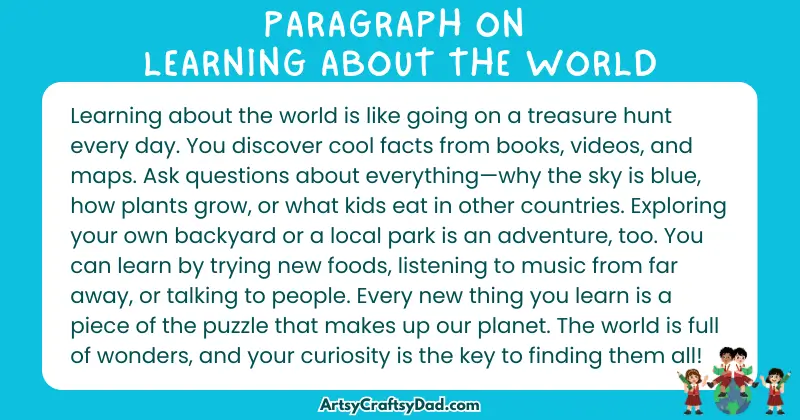
Learning about the world is like going on a treasure hunt every day. You discover cool facts from books, videos, and maps. Ask questions about everything—why the sky is blue, how plants grow, or what kids eat in other countries. Exploring your own backyard or a local park is an adventure, too. You can learn by trying new foods, listening to music from far away, or talking to people. Every new thing you learn is a piece of the puzzle that makes up our planet. The world is full of wonders, and your curiosity is the key to finding them all!
‘Learning About The World’ Essay Writing
‘Learning About The World’ – 150 to 200 Words Essay for Grades 5 to 7 Students
Learning about the world is the biggest and best adventure you will ever have! It doesn’t only happen in a classroom. It starts by being curious, like a detective. When you watch a line of ants carrying a crumb, you’re learning about animal teamwork. When you help measure ingredients for a cake, you’re learning about math and science. Every time you ask, “How does that work?” or “Why is it like that?” you are opening a new door.
You learn by using your amazing senses. Squish mud between your toes, smell rain on hot pavement, listen to the different songs of birds, and taste a new fruit. These experiences are your first lessons. Books and maps can then take you to oceans, deserts, and outer space you can’t visit yet. Remember, there are no silly questions. Every explorer gets lost sometimes, but that’s how new paths are discovered. So, look around with wonder—your world is waiting to teach you its secrets!
‘Learning About The World’ – 300 Words Essay for Grades 8 to 10 Students
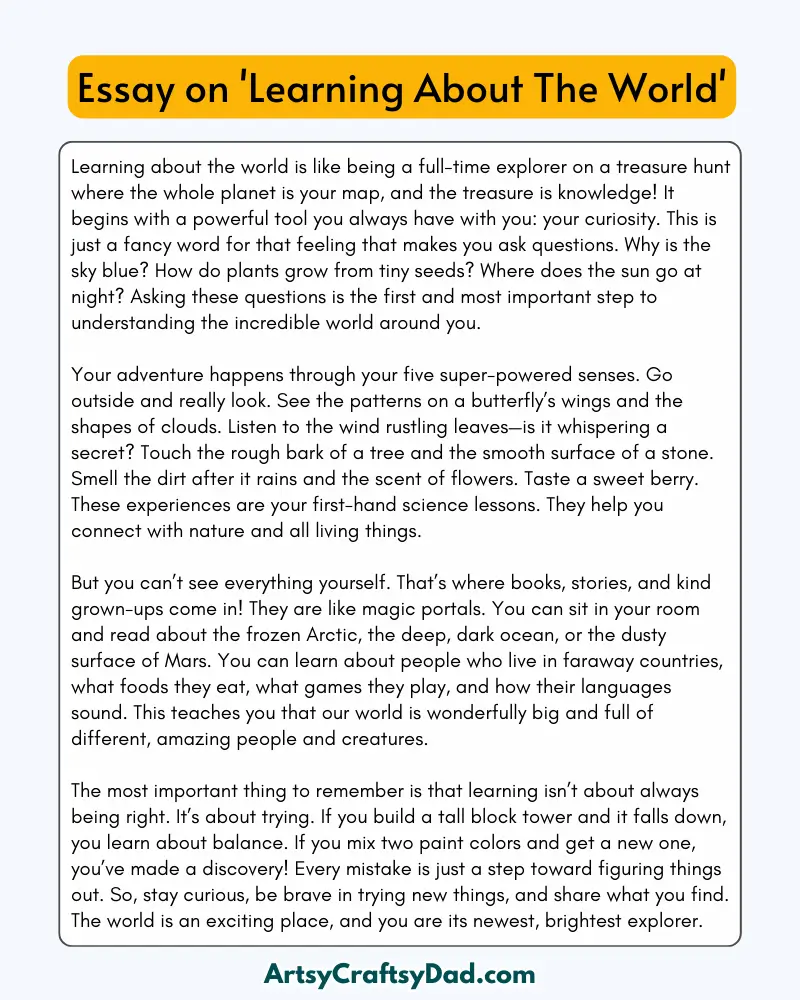
Learning about the world is like being a full-time explorer on a treasure hunt where the whole planet is your map, and the treasure is knowledge! It begins with a powerful tool you always have with you: your curiosity. This is just a fancy word for that feeling that makes you ask questions. Why is the sky blue? How do plants grow from tiny seeds? Where does the sun go at night? Asking these questions is the first and most important step to understanding the incredible world around you.
Your adventure happens through your five super-powered senses. Go outside and really look. See the patterns on a butterfly’s wings and the shapes of clouds. Listen to the wind rustling leaves—is it whispering a secret? Touch the rough bark of a tree and the smooth surface of a stone. Smell the dirt after it rains and the scent of flowers. Taste a sweet berry. These experiences are your first-hand science lessons. They help you connect with nature and all living things.
But you can’t see everything yourself. That’s where books, stories, and kind grown-ups come in! They are like magic portals. You can sit in your room and read about the frozen Arctic, the deep, dark ocean, or the dusty surface of Mars. You can learn about people who live in faraway countries, what foods they eat, what games they play, and how their languages sound. This teaches you that our world is wonderfully big and full of different, amazing people and creatures.
The most important thing to remember is that learning isn’t about always being right. It’s about trying. If you build a tall block tower and it falls down, you learn about balance. If you mix two paint colors and get a new one, you’ve made a discovery! Every mistake is just a step toward figuring things out. So, stay curious, be brave in trying new things, and share what you find. The world is an exciting place, and you are its newest, brightest explorer.
Related Essay & Paragraph Topics
- Exploring Different Cultures Around the World
- The Importance of Geography in Understanding Our Planet
- How Travel Helps Us Learn About the World
- The Role of Science in Discovering New Things
- Learning From Nature and the Environment
You May like this:
Standing Against Injustice

Opposing injustice promotes courage, moral responsibility, and social reform. Speaking against unfairness strengthens democratic values, supports human rights, encourages equality, and inspires others to defend truth and fairness.
Being Sensitive To Others
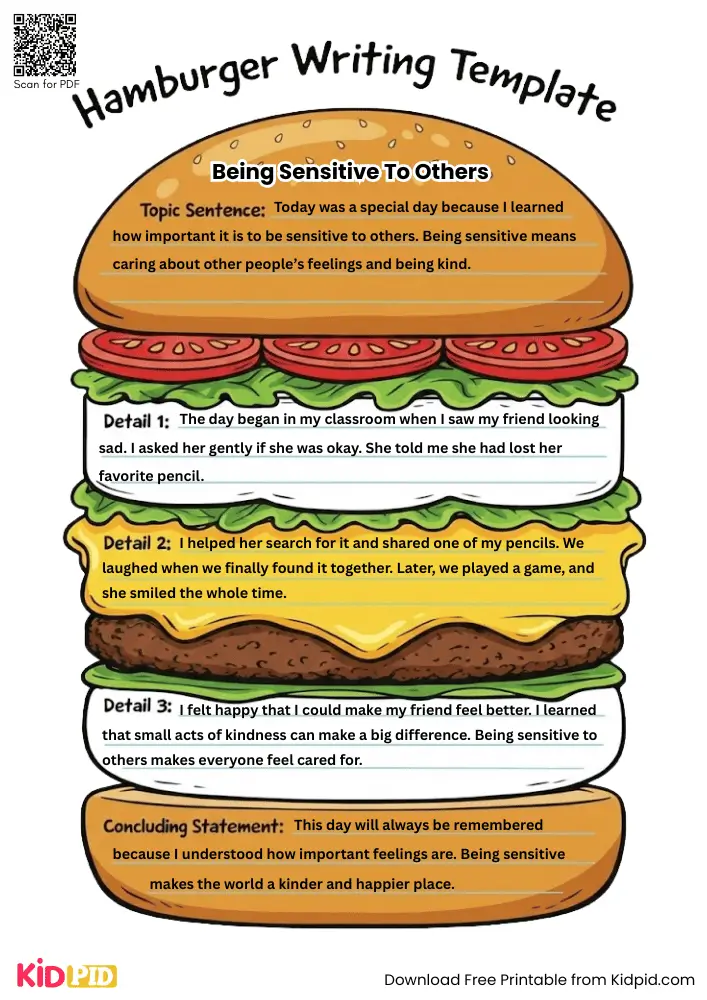
Emotional sensitivity improves empathy, relationships, and communication. Understanding others’ feelings fosters kindness, compassion, and respect, helping create supportive environments that encourage trust, cooperation, and strong social connections.
Respecting Differences
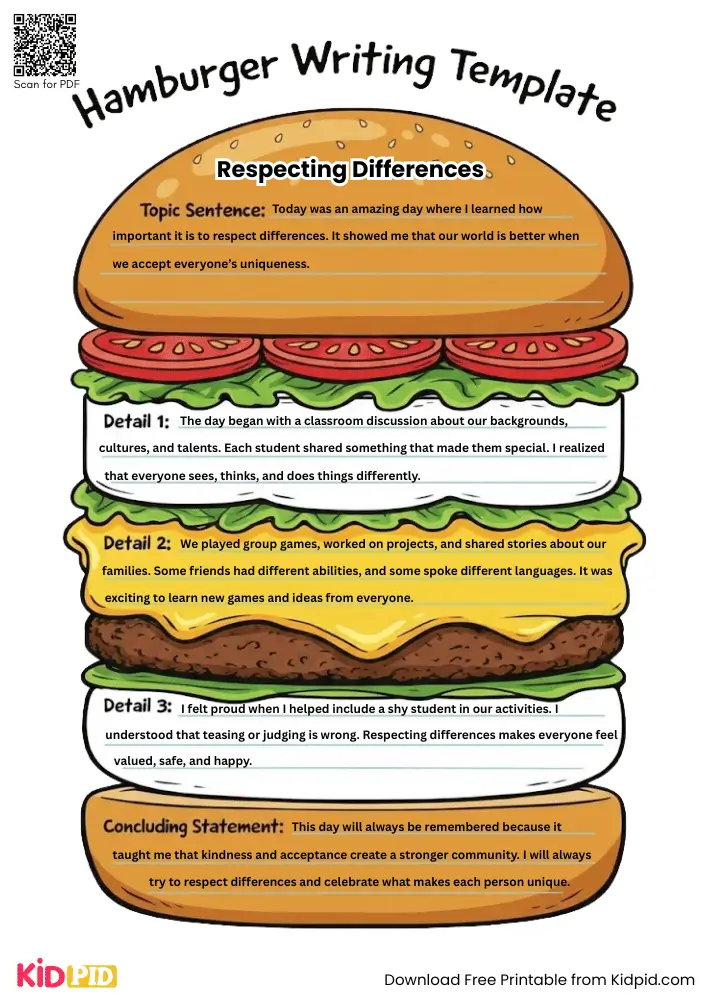
Respecting diversity encourages inclusion, tolerance, and peaceful coexistence. Accepting cultural, social, and personal differences strengthens relationships, promotes equality, reduces conflicts, and builds a harmonious, respectful, and understanding society.
Understanding Social Responsibilities

Social responsibility promotes ethical behavior, civic awareness, and community welfare. Respecting rules, helping others, and contributing positively strengthen society, build trust, and encourage responsible citizenship for sustainable development.
Trusting Inner Voice

Listening to intuition improves decision-making, self-awareness, and confidence. Trusting inner guidance helps avoid mistakes, promotes authenticity, strengthens emotional intelligence, and supports thoughtful choices aligned with personal values and long-term goals.