“Seasons change because the Earth tilts as it moves around the Sun. Different parts of the Earth receive more or less sunlight during the year. This causes summer, winter, spring, and autumn. The tilt affects weather, temperature, and day length, creating seasonal changes across the world.”
5 Pointers on “What Causes Seasons to Change”
- Seasons change because the Earth moves around the Sun.
- The Earth is tilted on its axis at an angle of about 23.5 degrees.
- Different parts of the Earth get more or less sunlight at different times of the year.
- When the Northern Hemisphere tilts toward the Sun, it becomes summer there, and winter in the Southern Hemisphere.
- Spring and autumn happen when neither hemisphere is tilted directly toward the Sun.
‘What Causes Seasons to Change’ Paragraph Writing
Hamburger Paragraph on ‘What Causes Seasons to Change’ (Free Template)
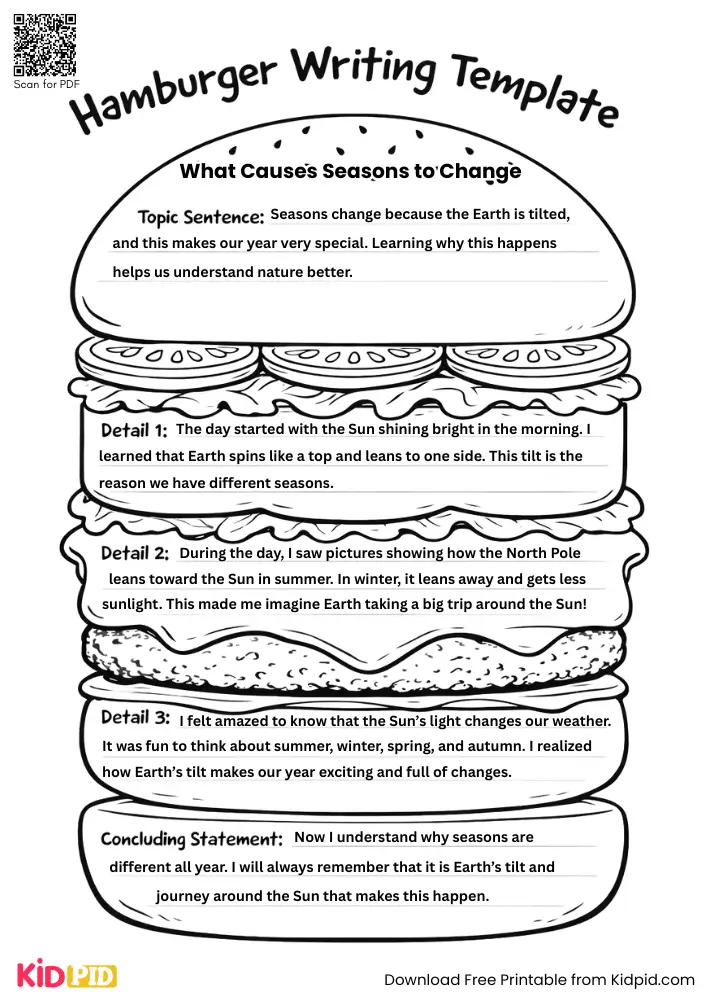
Topic Sentence : Seasons change because the Earth is tilted, and this makes our year very special. Learning why this happens helps us understand nature better.
Details 1 : The day started with the Sun shining bright in the morning. I learned that Earth spins like a top and leans to one side. This tilt is the reason we have different seasons.
Details 2 : During the day, I saw pictures showing how the North Pole leans toward the Sun in summer. In winter, it leans away and gets less sunlight. This made me imagine Earth taking a big trip around the Sun!
Details 3 : I felt amazed to know that the Sun’s light changes our weather. It was fun to think about summer, winter, spring, and autumn. I realized how Earth’s tilt makes our year exciting and full of changes.
Concluding Statement : Now I understand why seasons are different all year. I will always remember that it is Earth’s tilt and journey around the Sun that makes this happen.
Short Paragraph on ‘What Causes Seasons to Change’ – 50 Words for Grade 3
Seasons change because the Earth is tilted. It spins at an angle as it goes around the Sun. For part of the year, the North Pole tilts toward the Sun, making summer there. At the same time, the South Pole tilts away, making winter. Half a year later, this swaps!
Long Paragraph on ‘What Causes Seasons to Change’ – 100 Words for Grades 4 to 5

Seasons happen because our planet is tilted, like a spinning top leaning to one side. As Earth travels around the Sun for a full year, this tilt doesn’t change. So, sometimes your part of the world leans toward the Sun. Then, sunlight hits more directly, bringing warmer summer days. Other times, your part leans away. Then, sunlight is spread out and hits at a lower angle, making cooler winter weather. It’s not because Earth gets closer or farther from the Sun. It’s all about the tilt! This is why seasons are opposite in the Northern and Southern Hemispheres.
‘What Causes Seasons to Change’ Essay Writing
‘What Causes Seasons to Change’ – 150 to 200 Words Essay for Grades 5 to 7 Students
Have you ever wondered why we wear shorts in July but need coats in January? The reason for our changing seasons is a fantastic space adventure! Imagine Earth is a giant spinning top, but it’s not straight up and down. It’s permanently tilted to one side. Now, picture this tilted Earth taking a year-long trip in a giant circle around the Sun.
This tilt is the secret! As we travel, sometimes the part of Earth where we live (the Northern Hemisphere) leans toward the Sun. When we lean toward it, the Sun’s rays hit us more directly, making the days warmer and longer. This is our summer! Six months later, on the other side of the Sun, our home is now leaning away. The sunlight reaches us at a slanted angle, spreading its energy out and making things cooler. The days are shorter, too. This is winter!
So, it’s not how close we are to the Sun, but our planet’s clever tilt as we orbit that gives us the wonderful, changing seasons of spring, summer, autumn, and winter!
‘What Causes Seasons to Change’ – 300 Words Essay for Grades 8 to 10 Students

The dance between the Earth and the Sun creates the wonderful cycle of seasons we enjoy all year long. To understand this dance, we need to know two special things about our planet. First, Earth spins like a top around an imaginary line called its axis. But this axis isn’t straight up and down—it’s tilted at an angle, like a globe leaning on a shelf. Second, while Earth spins every day, it’s also taking a very long journey, orbiting the Sun once every year.
This tilt is the superstar of our seasonal show! As Earth makes its year-long orbit, the tilt stays pointing in the same direction in space. This means that for half the year, the top half of the planet (the Northern Hemisphere) leans toward the Sun. Think of shining a flashlight directly on a table—you get a bright, focused spot of light. That’s like summer sunlight! It’s more direct and powerful, bringing us warmth and making the days nice and long. We get more hours of sunshine to play outside.
After about six months, Earth has moved to the other side of the Sun. Our hemisphere is now leaning away from the Sun. The sunlight hits us at a slanted, lower angle. Now, imagine tilting that flashlight so the light stretches out into a weak oval. That’s winter sunlight! The same amount of light is spread over a larger area, so it doesn’t warm us as much. The days are also much shorter, with fewer hours of sunlight.
This amazing cosmic ballet gives us all four seasons! Spring and autumn are the gentle in-between times when neither hemisphere is leaning strongly toward or away from the Sun. So, remember, seasons change because our beautifully tilted Earth takes a grand voyage around the Sun, sharing the spotlight of its rays in different ways throughout the year. It’s not about distance, but all about the angle of the light!
Related Essay & Paragraph Topics
- The Earth’s Tilt and Seasonal Changes
- Why We Have Four Seasons
- How the Sun Affects Our Seasons
- The Science Behind Changing Weather
- Understanding Summer, Winter, Spring, and Fall
You May like this:
Role Of Discipline In Environmental Care

Explains how disciplined habits like saving water, reducing waste, and keeping surroundings clean support environmental protection. Encourages responsible behavior, sustainable living, and eco-friendly practices.
How Daily Actions Impact Nature

Explains how everyday actions like waste disposal, energy use, and water conservation affect the environment. Encourages mindful habits and sustainable practices.
Importance Of Reducing Unnecessary Consumption

Discusses how reducing unnecessary consumption helps conserve resources and reduce pollution. Encourages mindful spending, sustainable living, and environmental responsibility.
Respecting Nature In Daily Life

Highlights how respecting nature through eco-friendly habits supports environmental balance. Promotes sustainability, conservation awareness, and responsible living.
How Children Can Protect Nature

Children can protect nature by planting trees, reducing waste, saving water, recycling materials, and practicing eco-friendly habits. Teaching environmental protection and sustainability helps build responsible future citizens.